


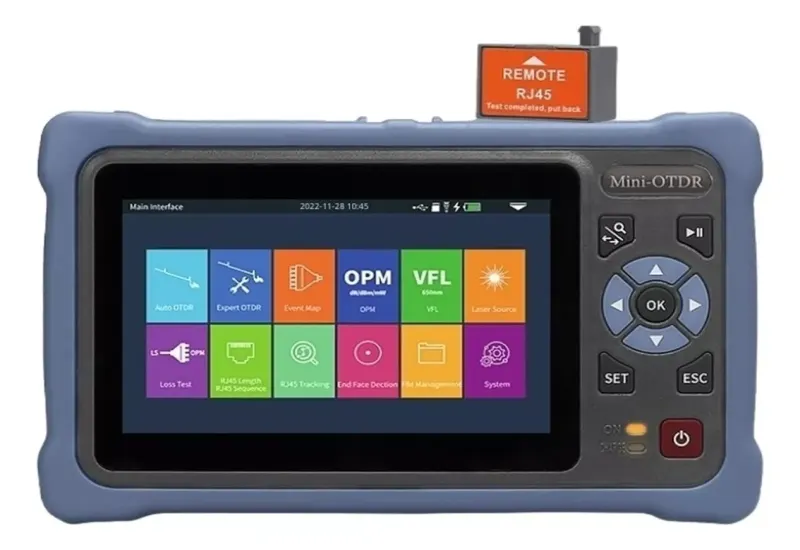
What an OTDR does
If you need to locate losses and breaks in fiber optic networks and know the distance to those faults, you need an OTDR. It is an optoelectronic instrument that lets you physically pinpoint the place in the network where maintenance is required.
The OTDR is used to find faults in fiber optic networks, especially in outside plant runs, where networks are extensive and locating faults along public roads is almost impossible.
How it works
The OTDR measures light pulses and analyzes their reflection and the time it takes to occur. From this it calculates the distance at which events occur, as well as length, fault location and discontinuities.
It consists of a laser diode source, a photodiode detector and a high-precision timing circuit.
The laser emits a light pulse at a given wavelength that travels along the fiber under test. As it travels, part of the light is reflected back to the OTDR photodetector. The intensity of this returning light and the time it takes to come back indicate the loss value (insertion and reflection) and the type and location of an event on the link.
Short-duration pulses encounter reflective events and fiber impurities, which send fractions of the pulse back to the launch port. Measuring the time between the launch of the pulse and the arrival of the return signal gives the distance between the launch point and the event.
Main functions and uses
1. Event location
Identifies the exact location of events such as splices, connectors, bends, breaks or any other discontinuity in the optical fiber. This is key to locating network faults quickly and accurately.
2. Attenuation measurement
Measures signal loss along the fiber. This is essential for verifying installation quality, detecting performance problems and confirming that the optical signal meets the required standards.
3. Reflectance analysis
Evaluates the amount of light reflected at each event and provides detailed information on the quality of connections and splices.
4. Fiber characterization
Characterizes the fiber by measuring parameters such as its length, attenuation per kilometer and dispersion, among others. This is key to planning, maintaining and troubleshooting fiber optic networks.
5. Problem diagnosis
Makes it easy to quickly identify breaks, excessive bends, connector contamination and other problems that affect network performance.