


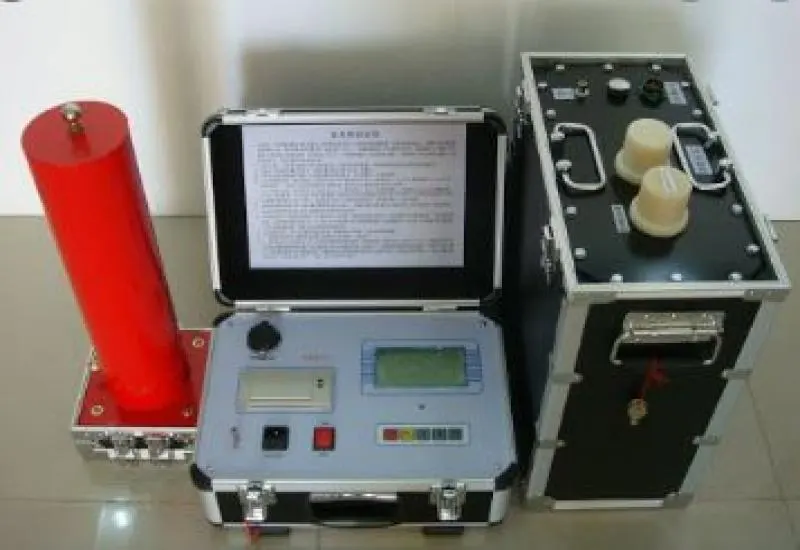
We have equipment up to 60kV for hipot testing in Monterrey, Nuevo León.
VLF cable testing
Very low frequency (VLF) testing detects insulation damage in the shortest possible time without affecting the quality of the insulating material. This technique is used to measure medium-voltage cables.
VLF testing can be used in two ways. The first is to measure insulation losses at different VLF frequencies, generally from 0.01 to 0.1 Hz. In this case, IEEE standard 400.2 sets the evaluation criterion. Partial discharge test accessories are available from several manufacturers of VLF test equipment. The second is to apply VLF to XLPE cables as a withstand test to detect faults in the cable system insulation. Here the cable must withstand a VLF AC voltage without disruptive discharges for a specified time.
The test uses different waveforms, generally sinusoidal and square. Voltages expressed in RMS (Root Mean Square) for different waveforms are not always applicable. The reference is taken from the peak voltage in each case.
- Frequency ranges are generally between 0.01 Hz and 0.1 Hz. The selection depends on the cable load.
- Voltage levels are calculated as a multiple of the rated cable voltage, normally between 1.5 U0 and 3 U0.
- Test time varies from 15 to 60 minutes. The utmost care must be taken when reducing the frequency, voltage or test time, because all of these directly affect the growth of water trees, which is the main purpose of the test on XLPE cables.
- VLF testing is a short, economical process for network operators. DC voltages were previously used to test cables, which sometimes damaged the insulation. DC testing, used successfully for decades on paper-insulated cables, is unsatisfactory for plastic cables and leads to serious failures.
The many failures of plastic-insulated cables that had passed the DC test confirmed the need for a new way of testing them. That is why VLF testing replaced DC testing.
The equipment is portable and operated by touch screen. It generates stable, low-distortion high voltage, with safe operation during field tests. It serves power generation, transmission and distribution companies, electrical contractors and industries that must verify insulation integrity before energizing a system or as part of their maintenance programs.
Applications
- VLF testing of medium-voltage power cables.
- Acceptance testing of XLPE and EPR cables.
- Insulation assessment in electric motors.
- Testing of electric generators.
- Diagnostics of industrial electrical systems.
- Preventive and predictive maintenance.
- Verification of insulation condition before commissioning.
Main features
- High-voltage generation at ultra-low frequency (VLF).
- Easy-to-use color touch screen.
- High stability and accuracy of the output voltage.
- Low-distortion waveform.
- Protection system against interruptions and faults during testing.
- Compact, portable design that is easy to transport.
- For laboratory work and field testing.
Technical specifications
| Parameter | Specification |
|---|---|
| Power supply | 220 V ±10 %, 50/60 Hz |
| Voltage stability | ≤ 1 % |
| Frequency stability | ≤ 3 % |
| Waveform distortion | < 5 % |
| Operating temperature | -10 °C to +40 °C |
| Relative humidity | ≤ 85 % non-condensing |
| Protection | Protection system against interruptions and overloads |
| Operation | Touch screen with digital control |
Benefits
- Reduces the risk of failures during commissioning.
- Makes it possible to assess insulation condition without large equipment.
- Highly stable VLF signal.
- Portable equipment for substations, industrial plants and distribution networks.
- For predictive and preventive maintenance programs.
VLF equipment functions
We offer a wide variety of equipment for VLF testing, including Creativeit Group models for high-voltage testing. Our equipment includes fully automatic tests, is short-circuit proof and has a timer that switches the device off automatically. The units are portable and easy to transport, come with guided menus in different languages and have an emergency stop button.
They are protected against water splashes and can operate in poor weather conditions. The user can define the automatic test sequences. A graphic display with a menu contains all the control functions. The compact design makes it easy to move and use on site.
Preparing for the test
To test cables, first prepare them:
- Disconnect all contacts of the test object, make sure it cannot be switched on again and check that it is de-energized.
- Isolate adjacent live parts and make sure that, when high voltage is applied, there are no breakdowns to adjacent parts of the wiring.
- On a multi-conductor object, ground all the other cables except the one being tested.
- Clean the terminals if necessary.