


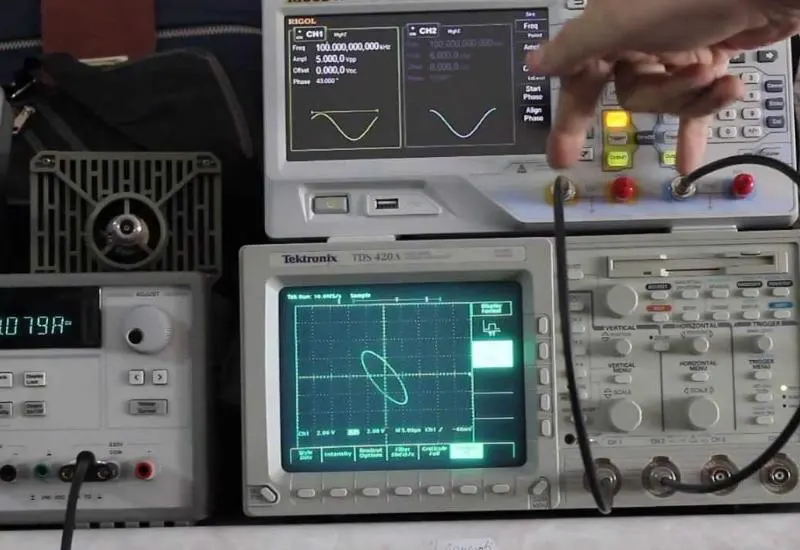
Video of Lissajous figures
Short video showing figures or patterns, and video, with the oscilloscope in XY and XYZ mode.
https://www.youtube.com/watch?v=V29LAoFBmoY
Lissajous curve
In mathematics, the Lissajous curve, also known as the Lissajous figure or Bowditch curve, is the graph of the system of parametric equations for the superposition of two simple harmonic motions in perpendicular directions.
In classical mechanics, the trajectory of a complex two-dimensional harmonic motion is a Lissajous curve.
It has several applications. For example, some optical supermarket scanners that check prices have a mechanical arrangement that reads the bar code with a light beam that generates Lissajous figures.
Properties
The appearance of the figure is very sensitive to the ratio between the frequencies of the motions in x and y. For a value of 1, the figure is an ellipse, with the special cases of the circle (A = B) and straight lines. Another simple Lissajous figure is the parabola (a/b = 2).
Other values of this ratio produce more complicated curves, which are closed only if the ratio is a rational number, that is, if the frequencies are commensurable. If the frequency ratio is not rational, the curve is not closed and is a dense set over a rectangle: it passes arbitrarily close to any point of that rectangle.
Exercise: Lissajous figures
Objectives
1. Visualize the formation of Lissajous figures using the oscilloscope.
2. Verify the influence of the amplitude and phase of each signal on the shape of the Lissajous figures.
Materials and equipment
- 1 oscilloscope
- 1 rheostat
- 1 signal generator
- 4 connectors
- 1 digital camera, which you must bring. If your cell phone is good enough, it will also work.
- 1 USB memory stick