


Video
Short video on the basic use of a spectrum analyzer.
http://www.youtube.com/watch?v=lSlcrhdVuM8
What a spectrum analyzer is
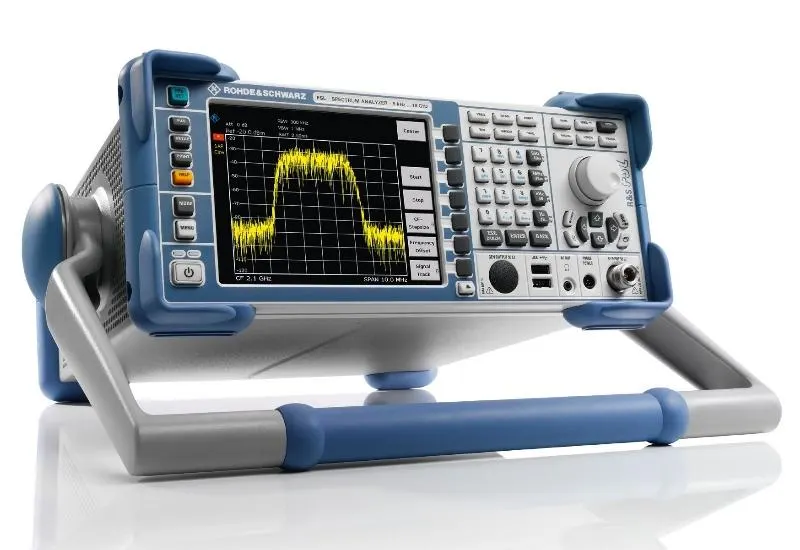
A spectrum analyzer takes any signal and obtains its frequency content. In other words, it plots the amplitudes of each of the harmonics that make up the signal.
Basic use of the spectrum analyzer
Physical phenomena can be converted into electrical signals with suitable transducers. These signals are studied as a function of time with an oscilloscope, or as a function of frequency with a spectrum analyzer.
The oscilloscope gives information on the amplitudes and time intervals of the electrical signal. The spectrum analyzer presents the amplitudes and frequencies of the different discrete components of that signal. In both cases the information is displayed on a cathode ray tube (CRT).
What measurements can be made
- Power and RMS voltage.
- Noise power.
- Signal-to-noise ratio.
- Frequency.
- Distortion.
- Amplitude modulation.
- Frequency and phase modulation.
- Spectral purity.
- Field strength.
This list includes only some of the possible measurements. Not all of them are achieved with the same accuracy as with dedicated equipment, because general-purpose equipment usually has lower accuracy than equipment designed for a single type of measurement.
In some situations the spectrum analyzer gives clearly better results. If you are studying a complex signal that, in addition to the fundamental, contains harmonics and spurious signals from varied and possibly unknown sources, measuring the fundamental frequency with a frequency counter or a power meter leads to an erroneous result. The spectrum analyzer delivers all the frequencies present and their associated powers, although with lower accuracy.
In short, it makes a wide variety of measurements possible with a single instrument. This makes it very useful in any laboratory, because in many cases it avoids buying specific, complete and costly equipment for each type of measurement.