


Video: how to measure current and diodes with a multimeter
A video that briefly explains how to measure current and diodes with a multimeter.
https://www.youtube.com/watch?v=Gj5FPFT5hxI
What diodes are
A diode is a two-terminal electronic component that allows electric current to flow in one direction only. The term usually refers to the semiconductor diode, the most common type today: a piece of semiconductor crystal connected to two electrical terminals. The vacuum diode (no longer used, except in high-power technologies) is a vacuum tube with two electrodes: a plate as the anode and a cathode.
In simplified form, the characteristic curve of a diode (I-V) has two regions: below a certain potential difference it behaves as an open circuit (it does not conduct), and above it, as a closed circuit with a very small electrical resistance. This is why they are called rectifiers: they can suppress the negative part of any signal, as an initial step in converting alternating current to direct current. Their operating principle is based on the experiments of Lee De Forest.
Electric current
Electric current is the flow of electric charge per unit of time through a material. It is due to the movement of charges (normally electrons) within the material. In the International System of Units it is expressed in C/s (coulombs per second), a unit called the ampere. Because it is a movement of charges, it produces a magnetic field, a phenomenon exploited in the electromagnet.
What a multimeter is
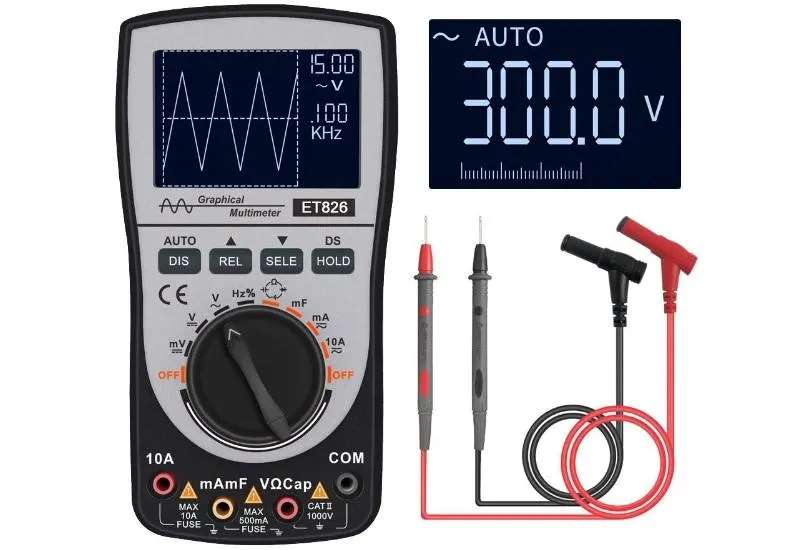
A multimeter is a device that measures the voltage, current or resistance of one or more elements of an electrical circuit. It is also called a tester and can be analog or digital. When it measures current it is called an ammeter; when it measures voltage, a voltmeter; and when it measures electrical resistance, an ohmmeter.
The analog multimeter
The analog multimeter has a moving-coil instrument (galvanometer). It consists of a rectangular winding that rotates around a vertical axis passing through its center. The coil sits between the north and south poles of a horseshoe-shaped permanent magnet (in other instruments, the magnet is inside the coil). When electric current flows through the coil, a torque appears that tends to turn it clockwise, and the needle turns with it. The deflection of the needle is proportional to the current flowing through the coil. To stabilize the position of the needle, an opposing torque is needed, which is generated by a spiral spring.