


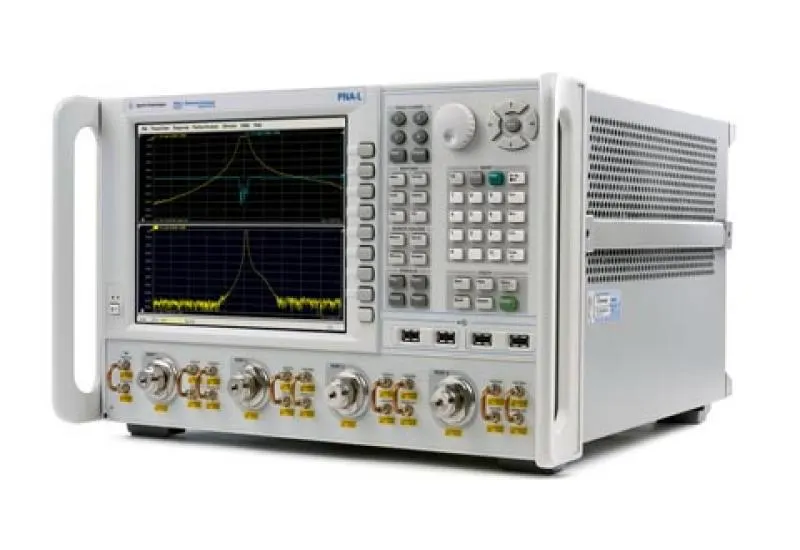
What the course includes
We have several vector network analyzers and calibration and verification kits for the most common connectors and waveforms on the market. With us you become familiar with this equipment and learn to make S-parameter measurements.
What a network analyzer is
It is an instrument that analyzes the properties of electrical networks, especially signal reflection and transmission, known as scattering parameters (S-parameters). It is used mainly at high frequencies; operating frequencies can range from 5Hz to 1.05THz.
It is widely used in the manufacture of high-power amplifiers and of filters for radio-frequency signals, to achieve the required precision in the response parameters.
Some special analyzers cover lower frequencies, down to 1 Hz. They are used, for example, to analyze open-loop stability or to measure audio and ultrasonic components.
Types of analyzer
- SNA (Scalar Network Analyzer): measures amplitude properties only.
- VNA (Vector Network Analyzer): measures amplitude and phase properties.
A VNA is also called a gain-phase meter or an automatic network analyzer. An SNA is functionally identical to a spectrum analyzer combined with a sweep generator. VNAs are the most common: when people say “network analyzer” without further detail, they usually mean a VNA.
Three major manufacturers are Keysight (formerly Agilent Technologies), Anritsu and Rohde & Schwarz.
Ports and operation
The most common models have two ports, but there are also four-port models. Some offer a touch screen and mouse or keyboard connection through PS/2 or USB ports. The most modern models run on a Windows platform, which simplifies their operation.