


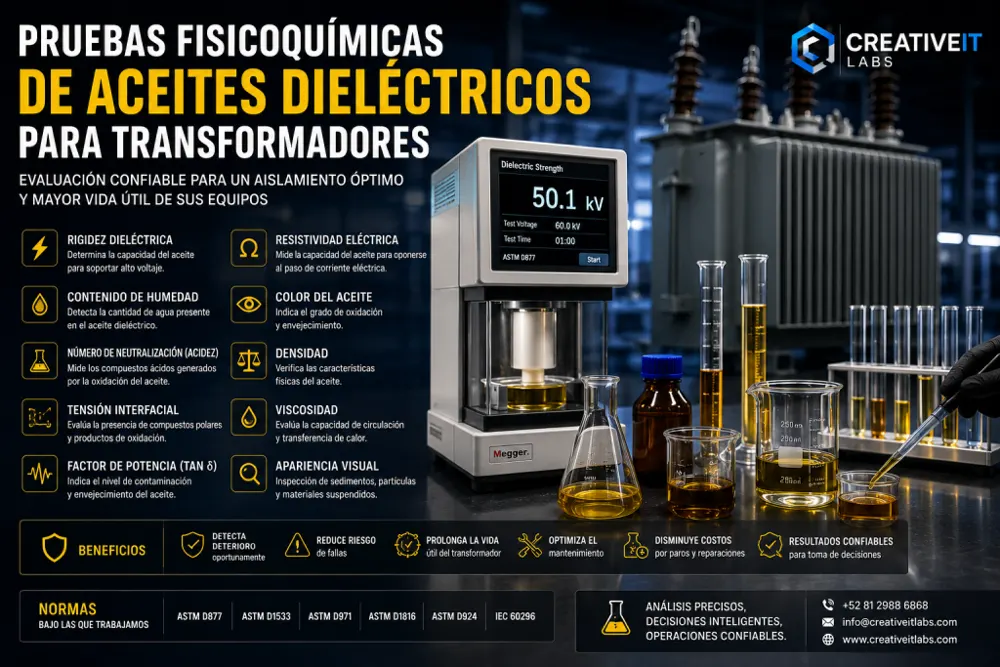
Evaluate the actual condition of your insulating oil
Dielectric oil is one of the most important elements in transformers, circuit breakers and other electrical power equipment. It provides electrical insulation, heat dissipation and protection against electrical discharges.
Over time, oil deteriorates because of moisture, oxidation, contamination, high temperatures and natural aging. Physicochemical tests show whether the oil is fit to remain in service, requires treatment or must be replaced.
At Creativeit Labs we perform tests to evaluate the physical, chemical and electrical properties of dielectric oils in accordance with national and international standards. The results feed predictive maintenance and asset management programs.
Tests we perform
Dielectric strength (breakdown voltage)
We evaluate the oil’s ability to withstand high voltages without an electrical discharge. This test detects contamination by moisture and particles, as well as degradation of the insulating fluid.
Moisture content
We determine the amount of water present in the oil. Water is one of the main factors that reduce insulation resistance and accelerate the aging of the transformer’s insulating paper.
Neutralization number (acidity)
We measure the content of acidic compounds generated by oil oxidation. Higher acidity promotes sludge formation, corrosion and insulation deterioration.
Interfacial tension
We evaluate oxidation products and polar contaminants by measuring interfacial tension, an indicator of oil aging.
Power factor / dissipation factor (Tan δ)
We determine the dielectric losses of the oil to evaluate its contamination level and its electrical behavior under operating conditions.
Electrical resistivity
We measure the oil’s ability to oppose the passage of electric current. This helps identify contamination, moisture or degradation.
Oil color
Color makes it possible to detect changes associated with aging, oxidation or contamination.
Density
We determine density to verify the physical characteristics of the oil and support its identification and quality control.
Viscosity
We measure kinematic viscosity to evaluate the oil’s ability to circulate and transfer heat inside the transformer.
Visual appearance
We inspect for sediment, particles, turbidity or suspended materials that may indicate contamination or degradation.
Benefits
- Detect oil deterioration in good time.
- Make it possible to plan predictive maintenance.
- Reduce the risk of unexpected transformer failures.
- Extend the service life of the insulation system.
- Lower the cost of major repairs.
- Help optimize maintenance programs.
- Provide information for technical decisions.
Equipment whose oil we analyze
- Power transformers.
- Distribution transformers.
- Instrument transformers.
- Electrical reactors.
- High-voltage circuit breakers.
- Tap changers (OLTC).
- Liquid-insulated electrical equipment.
Sectors we serve
- Power generation companies.
- Electrical substations.
- Manufacturing industry.
- Mining sector.
- Oil and gas industry.
- Automotive industry.
- Electrical maintenance centers.
- Engineering companies.
- Industrial plants.
- Electrical contractors.
Why Creativeit Labs
- Laboratory specialized in dielectric oil analysis.
- High-precision instrumentation for physicochemical testing.
- Trained technical staff.
- Procedures based on ASTM and IEC standards.
- Clear, complete technical reports, with interpretation of results.
- Fast turnaround and personalized service.
Condition-based maintenance
Physicochemical tests show the condition of the oil before serious failures appear. With periodic monitoring it is possible to detect degradation trends, schedule timely interventions and avoid costly downtime.