


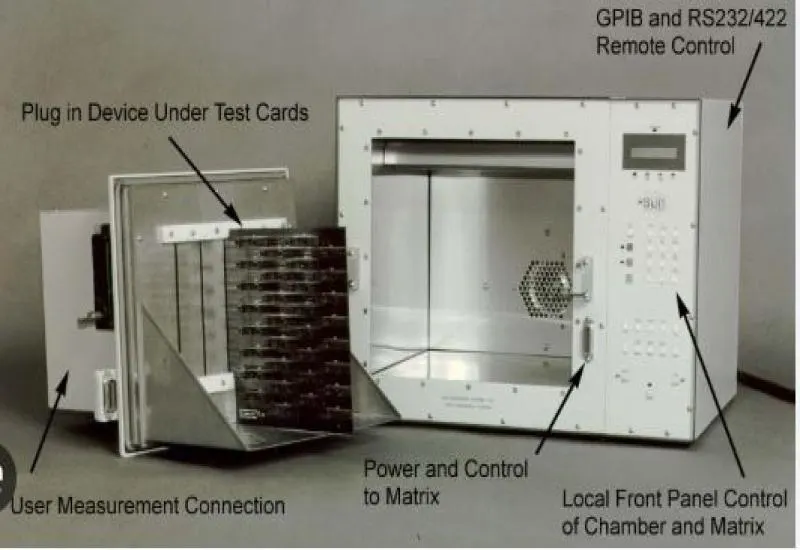
Thermal cycling and accelerated aging
We run thermal cycling programs to evaluate the accelerated service life of components, thermal fatigue in solder joints, contacts and composite materials, and electrical degradation over time. Profiles can be designed to customer requirements or qualification standards, or to replicate field conditions.
Capabilities and ranges
- Programmable thermal cycles with ramp and dwell control.
- Operation between temperature extremes defined by the customer; integration of electrical test points during the cycles.
- Continuous monitoring of electrical parameters: insulation resistance, S-parameters, noise figure, leakage current, capacitance and impedance.
Methodology
- Test plan design, defining the number of cycles, ramps (°C/min), time at the hot and cold points and failure criteria.
- In-process instrumentation: data loggers, event recorders, a VNA for S-parameters, impedance analyzers and oscilloscopes to capture transient events during the temperature change.
- Tracking and statistical analysis: determination of mean time to failure (MTTF) in long-duration tests and analysis of the failure distribution.
Applicable standards
- IEC 60068-3 and the IEC 60068-2 series for environmental test methods.
- JEDEC JESD22-A104D for thermal cycling of semiconductor components (if applicable).
- MIL-STD-202 and MIL-STD-750 for specific components.
Reports and results
- Degradation curves by number of cycles.
- Correlation between electrical parameters and cycles (gain loss, noise increase, impedance variation).
- Recommendations for improving design and materials.
Metrological temperature control
In our environmental analyses and laboratory tests where temperature is a critical parameter, we ensure metrological control through in-house verification of our thermal systems. Each test is backed by temperature validation in our dry-well calibrator, with an operating range of -30 °C to 150 °C, resolution of 0.01 °C, thermal stability of ±0.02 °C and display accuracy of ±0.1 °C.
Block uniformity (horizontal ≤ ±0.05 °C) and the controlled vertical gradient are also evaluated. This confirms that measurements remain within the established uncertainties and that test conditions are stable, uniform and accurate. The expanded uncertainty of the system is determined according to the operating point, the sensor under test and the process conditions.