


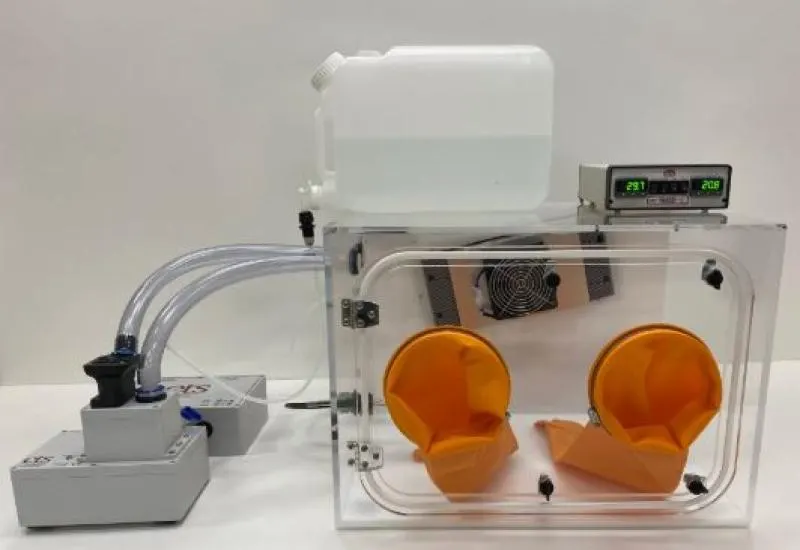
THB (Temperature Humidity Bias) testing
At our Monterrey laboratory we have the equipment to evaluate electrical degradation under combined conditions of temperature, humidity and electrical bias. These tests are critical for detecting ion migration, trace corrosion, package degradation and insulation failures.
Service features
- Fine control of relative humidity and temperature with the Sun EC01 chamber and ETS 514.
- Application of electrical bias to devices or boards under test during the exposure period.
- Real-time monitoring of leakage currents, insulation resistance and functional behavior.
Procedure
- Definition of the humidity level, temperature and bias voltage.
- Setup with safe power routing and connection to current/voltage recorders.
- Execution for the required time (hours to thousands of hours) with periodic logging and programmable alarms.
- Subsequent inspection with electrical techniques and, optionally, physicochemical analysis to identify corrosion or deposits.
Standards and references
- JEDEC JESD22-A101B (preconditioning and humidity tests) according to device type.
- IEC 60068-2-78 for constant humidity tests.
- ASTM B117 for salt spray tests (if correlation with corrosion from saline environments is required).
- IPC-TM-650 for evaluating effects on PCBs.
Deliverables
- Log of electrical drift and leakage currents.
- Report with failure analysis, photographs and mitigation recommendations.
Metrological temperature control
In our environmental analyses and laboratory tests where temperature is a critical parameter, we verify our thermal systems in-house. Each test is backed by temperature validation using our dry-well calibrator, with an operating range of -30 °C to 150 °C, resolution of 0.01 °C, thermal stability of ±0.02 °C and display accuracy of ±0.1 °C.
Block uniformity (horizontal ≤ ±0.05 °C) and the controlled vertical gradient are also evaluated. This makes it possible to confirm that measurements remain within the established uncertainties, and with that the stability, uniformity and accuracy of the test conditions. The expanded uncertainty of the system is determined based on the operating point, the sensor under test and the process conditions.