


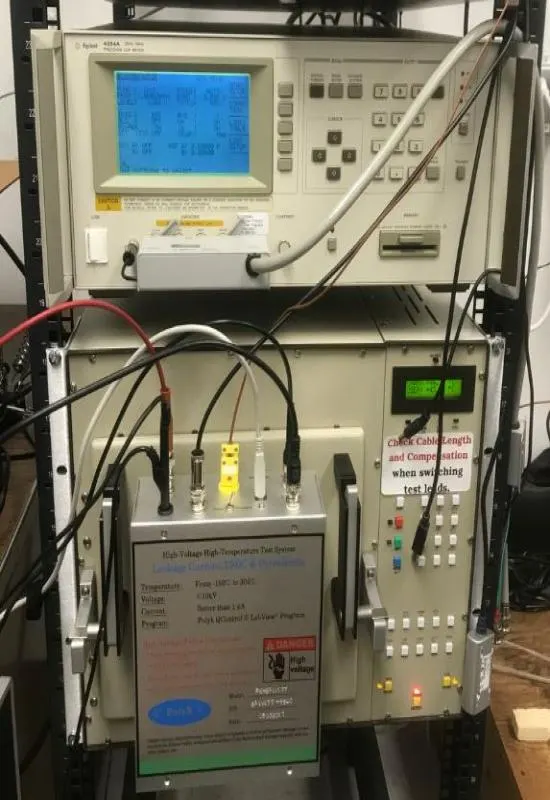
Testing to ASTM D257
We perform surface resistance and DC conductance tests in accordance with ASTM D257 – Standard Test Methods for DC Resistance or Conductance of Insulating Materials, widely used to characterize insulating, dissipative and ESD materials electrically.
The method applies to flat surfaces and evaluates the electrical behavior of the material under controlled DC voltages, using high-resistance megohmmeters and standardized electrode configurations.
Test parameters under ASTM D257
The tests follow the parameters defined by the standard and are adapted to the technical requirements of each material.
- DC test voltage: typical value of 100 V DC at 25 °C, with the option of applying higher voltages when the method and material allow it, in accordance with ASTM D257.
- Temperature: measurement at room temperature or under controlled conditions, in a range from –78 °C to 300 °C depending on the application and material.
- Controlled environmental conditions: standard laboratory environment, controlled relative humidity, and vacuum or controlled atmosphere for advanced studies.
These configurations make it possible to evaluate the influence of environmental factors on the surface resistance and electrical conductance of the material.
Measurement with guard ring electrode
To improve accuracy and minimize errors from surface leakage currents, we use an electrode configuration with a guard ring, in line with the practices described in ASTM D257. This is especially important for:
- High-resistivity materials.
- Thin films.
- Low-conductance surfaces.
- Precision electrical characterization tests.
Sample types
The ASTM D257 method applies to a wide variety of materials and geometries, including:
- Thin polymer films, from 5 µm thick.
- Plastic sheets and plates more than 3 mm thick.
- Ceramic materials such as alumina (Al₂O₃) and aluminum nitride (AlN).
- Samples on silicon wafers.
The tests serve both materials development and quality control and ESD validation.
Application in ESD control
Surface resistance to ASTM D257 provides key information for evaluating the electrical performance of materials used in ESD control programs, component design, electronics manufacturing and quality assurance. The results make it possible to classify materials and document their electrical behavior under defined, reproducible conditions.
Volume resistance
In addition to surface resistance, volume resistance tests can be performed, in which the current passes through the thickness of the material. They are carried out in accordance with ASTM D257, with guard ring electrodes and high-resistance megohmmeters, and characterize the actual dielectric behavior of insulating and dissipative materials.