


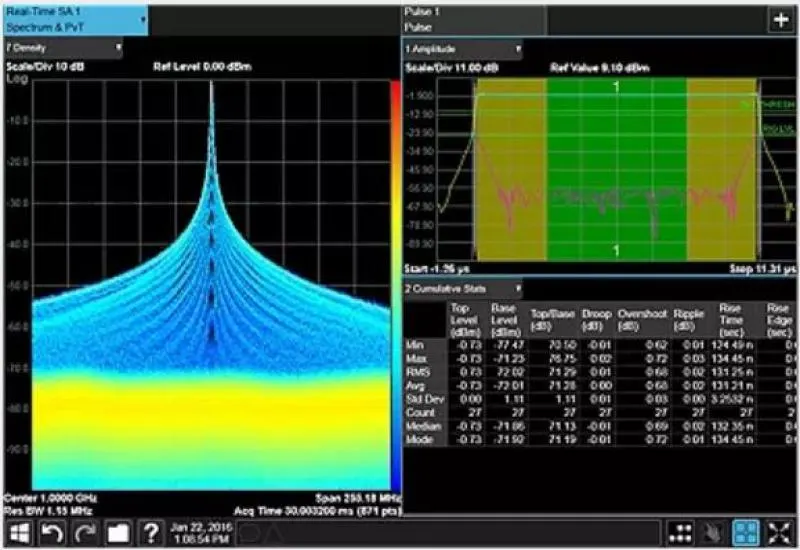
In Monterrey we have spectrum analyzers with digital processing software. They are used to check the robustness of any WiFi, GPS and satellite link installation.
WiFi
802.11a/g/n/ac/ax (standard WiFi)
- OFDM (Orthogonal Frequency Division Multiplexing): a modulation scheme that divides the bandwidth into multiple orthogonal subcarriers to increase spectral efficiency and mitigate the effects of interference.
- 64-QAM (Quadrature Amplitude Modulation): a modulation that combines amplitude and phase to transmit more bits per symbol. It is used in high-speed WiFi.
802.11b/g/n/ac (legacy WiFi)
- DSSS (Direct Sequence Spread Spectrum): a technique that spreads the signal over a wider bandwidth than necessary, which increases resistance to noise and interference.
Bluetooth
Bluetooth Classic (BR/EDR)
- GFSK (Gaussian Frequency Shift Keying): a frequency shift modulation that uses a Gaussian filter to improve spectral efficiency.
- QPSK (Quadrature Phase Shift Keying): a modulation that combines phase and amplitude changes to transmit two bits per symbol.
Bluetooth Low Energy (BLE)
- GFSK (Gaussian Frequency Shift Keying): as in Bluetooth Classic, it is used for its efficiency and robustness in noisy environments.
GPS (Global Positioning System)
DSSS (Direct Sequence Spread Spectrum)
In the GPS system, the signal is modulated with DSSS to provide resistance to interference and improve reception accuracy in environments with multiple interference sources.
DSSS is a modulation technique in which the digital signal is spread across the spectrum with a pseudorandom (PN) sequence known to both the transmitter and the receiver.
This technique helps mitigate the effects of interference and noise: the modulated signal is spread over a wider bandwidth than necessary and becomes less vulnerable to selective interference.
LTE (Long-Term Evolution)
OFDMA (Orthogonal Frequency Division Multiple Access)
LTE uses OFDMA in the physical layer to transmit data on the downlink (from the base station to the mobile device). OFDMA divides the available bandwidth into multiple orthogonal subcarriers, which can be assigned to different users or services.
Each subcarrier can be modulated with different digital schemes, such as QPSK, 16-QAM and 64-QAM, depending on channel conditions and signal quality.
SC-FDMA (Single Carrier Frequency Division Multiple Access)
On the uplink (from the mobile device to the base station), LTE uses SC-FDMA. It is a form of single-frequency modulation that provides spectral efficiency and reduces transmitter complexity compared with OFDMA.
Digital modulation
LTE uses several digital modulation schemes depending on channel conditions and signal quality. The most common are QPSK (Quadrature Phase Shift Keying), 16-QAM and 64-QAM (Quadrature Amplitude Modulation). QPSK is more robust and is used with weak signals. 16-QAM and 64-QAM achieve higher data rates with stronger signals and less interference.
Applications by frequency range
- 4G LTE and 5G NR cellular networks: fourth-generation (4G LTE) and fifth-generation (5G NR) mobile networks use frequencies in the 600 MHz to 6 GHz range to provide high-speed data connectivity to mobile devices.
- Radar: radar systems use frequencies in the 3 GHz to 6 GHz range for military, weather, air traffic and maritime applications, among others.