


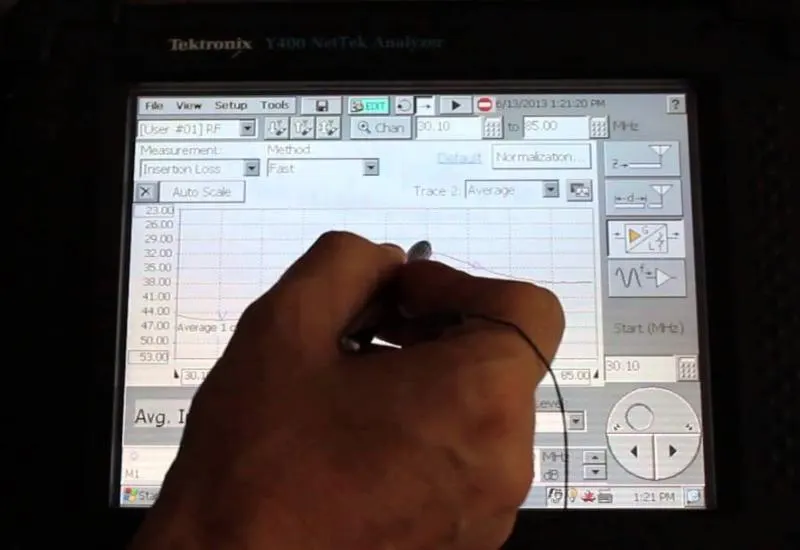
Characterization video
Short video showing the characteristics of a radio-frequency filter, where we mark its drop to minus 3dB from the signal peak.
What a network analyzer is
A network analyzer is an instrument that analyzes the properties of electrical networks, especially those associated with the reflection and transmission of electrical signals, known as scattering parameters (S-parameters). It is used most often at high frequencies, between 9 kHz and 110 GHz.
It is widely used in the manufacture of high-power amplifiers and of filters for radio-frequency signals, to achieve the required precision in the signal response parameters.
There are also special network analyzers that cover lower frequencies, down to 1 Hz. They can be used, for example, in open-loop stability analysis or to measure audio and ultrasonic components.
Calibration
Calibrating a network analyzer is a high-precision process. It must take into account the operating impedance (50 Ohms in cellular telephony or 75 Ohms for other applications) and the conditions in which the equipment operates. Depending on how many S-parameters are measured, the process can be long and tedious because of the number of times it has to be repeated.
The calibration standard uses three test devices: OPEN (open network), SHORT (short-circuited network) and THRU (connected network). They are connected to the analyzer ports so that it can compare and establish the difference between the three modes. The data are saved in a register, and each register must be calibrated independently and every time the network under study is modified.
Another option is the electronic calibration module (E-Cal). It connects to the analyzer, is recognized automatically and is more accurate than manual calibration. Its only apparent disadvantage is that you have to wait until it reaches its operating temperature before using it.
Bandpass filter with precise control of center frequency and bandwidth using RF MEMS switches
A reconfigurable bandpass filter capable of switching between two states, with a center-frequency tuning range of 24% in the C band. The center frequency and bandwidth are precisely controlled by a switchable filter topology that includes two folded resonator extensions switched by four ohmic-contact cantilever MEMS (microelectromechanical systems) switches.
The filter was designed for center frequencies of 5 and 6.2 GHz, with fractional bandwidths of 7 and 3%, respectively. It is fabricated on a quartz substrate, and the measured responses agree well with the simulations. The filter specifications were met with the proposed topology.