


What a transient is
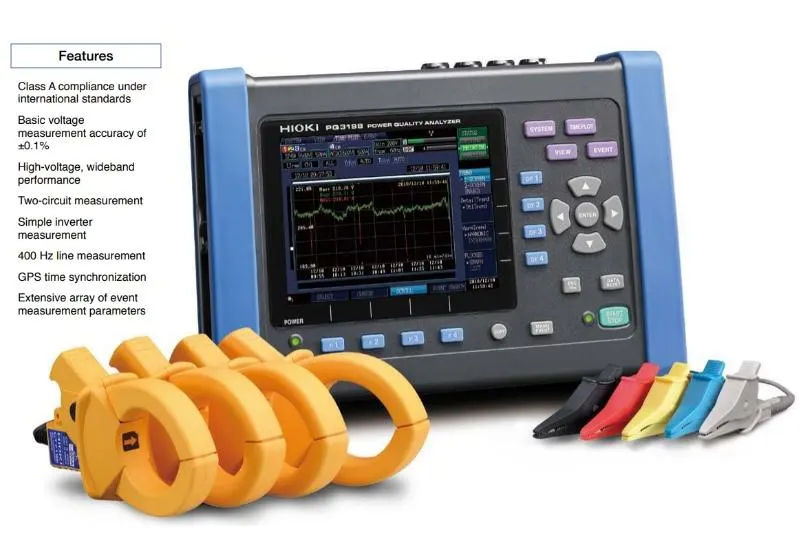
We have professional equipment for recording and monitoring transients. A transient is a disturbance in the AC waveform lasting less than half a cycle, evident from its abrupt discontinuity. It can be of either polarity and additive or subtractive with respect to the nominal wave. You will find the trained staff and the necessary equipment with us.
IEEE C62.41-1991 standard
The IEEE C62.41-1991 standard, Recommended Practice on Surge Voltages in Low-Voltage AC Power Circuits, does not seek to establish performance parameters for protective equipment. It presents guidelines on application parameters and the actions users must implement to achieve the desired protection against transients.
Origin of transients
Voltage transients in low-voltage power circuits have two origins: lightning, direct and indirect, and system switching.
- The occurrence and level of switching transients depend on the power supplier’s mode of operation, for example the switching of capacitor banks or circuits.
- Transients from switching internal loads depend on the nature and impedance of the adjacent loads and on their electrical distance from the point of interest, rather than on the geographic location or the supplier’s practices.
- Transient levels depend on grounding practices and on the layout of the distribution system: open overhead lines, overhead lines with twisted conductors, and cables.
In the sparkover of wiring devices, the withstand capability may be enough for an indoor device to survive, but outdoors a withstand capability of 10 kV or more may be required.
Short-duration voltage variations
They are generally classified as:
- Instantaneous variations: 0.5 cycle ≤ t ≤ 30 cycles
- Momentary variations: 30 cycles ≤ t ≤ 3 seconds
- Temporary variations: 3 seconds ≤ t ≤ 1 minute
Their consequences are:
- Temporary voltage drops (voltage sag).
- Temporary voltage increases (voltage swell).
- Temporary complete loss of voltage (interruption).
Sags are reductions in the RMS value of the voltage, with typical intervals of 0.5 to 30 cycles. Their effects fall on the starting of large induction motors in electrical systems. A momentary interruption is the total loss of voltage, with typical intervals of no more than 2 to 5 seconds. Its consequences include the increase in complaints in recent years.
Types of transients
The events reported in various studies can be simplified into 3 types of transients, including:
- Oscillatory waves (ring wave): those of higher frequency have limited energy capacity but high voltages; those of lower frequency have greater energy capacity but lower-amplitude voltages.
- High-energy transients of various waveforms, associated with nearby lightning, fuse operation or capacitor switching.