


Analyses we perform
- Analysis and characterization of solar photovoltaic cells.
- Measurement of solar panel inverter efficiency.
- Measurement of output voltage from module/string up to 1000V DC.
- Measurement of output current from module/string up to 10A DC.
- Measurement of solar irradiance [W/m2] with a reference cell.
- Temperature measurement, automatic or with a special probe.
- Measurement of DC output and nominal power of the module/string.
- Numerical and graphical integration of the I-V characteristic.
- Measurement of the series resistance of photovoltaic modules.
- Measurement of IGBT modules and IPM modules for photovoltaic applications.
We use calibrated equipment and incorporate the accessories needed to take the useful parameters of the analysis into account. Several parameters important for characterizing solar cells are built automatically into the instruments’ algorithms.
Inverter efficiency
Solar (photovoltaic) inverters today offer an energy conversion efficiency of between 95 % and 98 %. It is worth making sure that your inverter meets what the manufacturer declares, or that it still does after a certain amount of use.
A solar inverter must regulate the value of the output voltage. This is achieved in three ways:
- Regulating the voltage before the inverter (DC/DC converters).
- Regulating the voltage in the inverter itself with a control system (varying the phase angle by means of pulse width modulation, PWM).
- Regulating at the inverter output (with an autotransformer).
What the I-V curve of a photovoltaic panel is
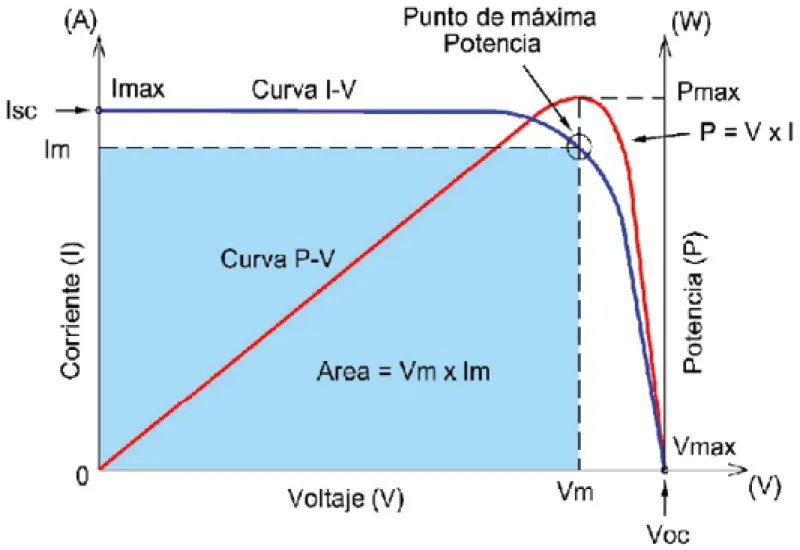
I-V curve tracers are specialized test instruments. They sweep an electrical load connected to the photovoltaic module or string and measure current and voltage at multiple points during the sweep.
Measuring the I-V curve with a tracer
The tracer evaluates the performance of photovoltaic modules by measuring their electrical response under different loads.
Initial setup
Connection: the tracer is connected to the module or string of modules being evaluated. It may need to be configured according to the panel specifications, such as its current capacity and maximum voltage.
Performing the measurement
Load variation: the tracer applies a range of electrical loads, from open circuit (infinite load, no current) to short circuit (zero resistance, maximum current). An internal mechanism varies the resistance in the tracer circuit and allows current and voltage to be measured at multiple points.
Data logging: as the load varies, the tracer measures and records the current (I) and voltage (V) at each point. These are used to plot the I-V curve of the panel.
I-V curve analysis
From the data, the tracer calculates key parameters: short-circuit current (Isc), open-circuit voltage (Voc), maximum power point (Pmax), fill factor (FF) and panel efficiency. These are the basis for evaluating the performance and condition of the photovoltaic system.
Diagnosis
The shape of the I-V curve makes it possible to identify partial shading, module degradation or faults in electrical connections. For example, a drop in Isc or Voc can indicate efficiency problems or panel damage.
Tips for measuring correctly
- Proper calibration: the tracer must be properly calibrated, especially with panels that have special characteristics, such as bifacial panels.
- Recording of environmental conditions: carefully record the panel temperature and solar irradiance to adjust the results to Standard Test Conditions (STC) or to nominal operating conditions (NOCT).
- Bifacial panels: it is advisable to use additional sensors that measure irradiance on the rear face and to adjust the data to properly reflect bifacial performance.