


Megger-type studies in Monterrey
We test generators and electric motors, and we rent out Megger equipment. We have the equipment needed to analyze single-phase and three-phase motors, compressors, pumps and other equipment. We carry out the analyses ourselves and give you an answer the same day you contact us.
We take videos and photographic evidence of the test results, in the laboratory or in the field. We only use professional equipment, whether for rental or for carrying out the analyses. Do not put your safety, that of your personnel or that of your equipment at risk.
Other tests: electrical insulation, power factor or tan delta dissipation, transformer turns ratio, oil dielectric breakdown, excitation current and polarity in transformers, motor starting currents, vibration in motors and other rotating equipment, thermography and motor torque tests.
We have a video of the tan delta (power or dissipation factor) machine on our YouTube channel:
https://www.youtube.com/watch?v=4dN3QvDXkNs&feature=youtu.be
Power quality and motor performance
We can locate, predict, prevent and resolve power quality problems in three-phase and single-phase distribution systems, in line with the Código de Red (grid code). We also provide the mechanical and electrical information needed to measure motor performance.
- On running motors we measure torque, revolutions per minute, mechanical power and efficiency.
- We calculate mechanical power and efficiency electrically, without mechanical sensors.
- We carry out dynamic motor analyses, plotting the derating factor against load, according to the NEMA standard.
- We measure voltage, current, power, apparent power, power factor, harmonic distortion and unbalance, to identify what affects motor efficiency.
- We identify sags, swells, transients, harmonics and unbalance.
We are members of the IEEE (Institute of Electrical and Electronics Engineers) and of the IEEE Dielectrics and Electrical Insulation Society (DEIS) # 94801861. This gives us access to current standards, professional forums and research material.
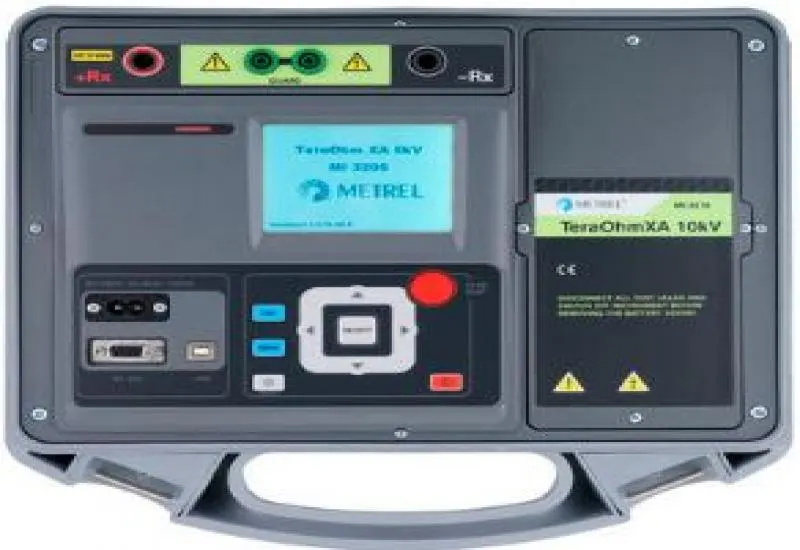
Megger equipment up to 10Kv and 10 Tera Ohms
We have professional Megger-type insulation equipment up to 10Kv and 10 Tera Ohms. Our tests can be carried out with these parameters:
- High insulation resistance measurement up to 10 Tohms.
- Programmable test voltage from 500 V to 10 kV, in 25 V steps.
- R(t) graphs, resistance over time.
- Programmable timer (from 1s to 30 min).
- Automatic discharge of the test object at the end of the measurement.
- Capacitance measurement.
- Measurement of resistance against test voltage (step voltage test).
- Five discrete voltage tests, set proportionally within the preset test voltage scale.
- Programmable timer from 1s to 30 min per step.
- Polarization index (PI), dielectric absorption ratio (DAR) and dielectric discharge ratio (DD).
- Dielectric strength voltage (DC) up to 10 kV.
- Programmable ramp test voltage from 500 V to 10 kV.
- High-resolution ramp (approx. 25 V per step).
- Programmable breakdown current up to 5 mA.
- Voltage and frequency measurement up to 600 V AC/DC.
- Results stored on the instrument or transferred to a PC.
PI = RINS (t2) / RINS (t1) – DAR = R1min / R15s – DD = Idis1min / C U
Insulation testing of transformers
The meaning of insulation resistance requires interpretation and depends on the design, dryness and cleanliness of the transformer’s insulation. The measurement procedure is described in the IEEE C57.12.90 standard. Its key points:
- The temperature of the windings and the insulating liquid must be close to 20 °C.
- All windings must be immersed in the same insulating liquid.
- All windings must be short-circuited.
- All transformer bushings must be in place.
- Terminals not under test, the housing and the tank must be grounded while the test voltage is applied.
Dielectric absorption and indices
Resistance varies directly with insulation thickness and inversely with its area. When a direct current voltage is suddenly applied, resistance starts at a low value and increases gradually until it stabilizes. Plotting resistance against time gives the dielectric absorption curve, whose slope indicates the relative degree of dryness and cleanliness of the insulation. If the insulation is damp or dirty, a stable value is reached in one or two minutes and the curve has a low slope.
The slope is expressed as the ratio of two readings taken at different times in the same test. The ratio of 60 to 30 seconds is known as the "absorption index", and the ratio of 10 to 1 minute as the "polarization index". Both are used to evaluate the condition of the windings of power transformers and generators.
Factors affecting the test
Resistance is notably reduced by dirt, relative humidity, temperature and electromagnetic induction. For dirt, remove all foreign matter (dust, carbon, oil, etc.) from the insulation surface. For humidity, testing above the dew point temperature is recommended. Insulation resistance varies inversely with temperature in most insulating materials: to compare periodic measurements, measure at the same temperature or convert each measurement to a common base with this equation:
- Rc = insulation resistance in megaohms corrected to the base temperature.
- Rt = insulation resistance at the test temperature.
- Kt = temperature correction coefficient.
The recommended base temperature is 20 °C for transformers and 40 °C for rotating machines. For circuit breakers, surge arresters, bushings, wall bushings and other equipment there is no base temperature, because the variation of their resistance with temperature is stable.
If the equipment is under electromagnetic induction, a shield must be set up to drain the induced currents to ground. A practical way is a multi-grounded metal mesh (Faraday cage) over the equipment, supported with insulating material, with strict safety measures because of the proximity of other energized equipment. The presence of a prior charge also has an effect; it can arise because the equipment works isolated from ground or from an application of DC voltage in an earlier test.
Measurement methods
- Short time: the instrument is connected to the equipment and operated for 60 seconds. It is applied mainly to small equipment and to equipment without notable absorption, such as circuit breakers, cables and surge arresters.
- Time-resistance or dielectric absorption: the test voltage is applied for 10 minutes, with readings at 15, 30, 45 and 60 seconds, and at 2, 3, 4, 5, 6, 7, 8, 9 and 10 minutes. It is applied mainly to power transformers and large rotating machines, because of their notable absorption.
Insulation resistance measurement is in itself a potential test, so it must be limited to values appropriate to the rated operating voltage and the condition of the insulation. A high voltage can fatigue the insulation. The direct current voltages commonly used are from 500 to 5,000 Volts.
Readings normally decrease at high potentials, but insulation in good condition gives similar values at different voltages. If resistance drops significantly when the voltage is raised, there may be imperfections or fractures in the insulation, possibly aggravated by dirt or moisture; the mere presence of moisture with dirt can also cause it.
Interpretation of results
These recommendations do not replace the judgment or experience of the technical personnel responsible for equipment maintenance.
To evaluate power transformers, it is advisable to analyze the trend of periodic test values and to plot the readings to obtain the dielectric absorption curves. A low slope indicates damp or dirty insulation. For better analysis, carry out the tests at the same potential, with readings corrected to a common base (20 °C) and, as far as possible, under the same environmental conditions.
The absorption and polarization indices, which relate to the absorption curve, must be calculated. The polarization index is obtained by dividing the resistance at 10 minutes by the resistance at 1 minute. The minimum values for considering the transformer acceptable are 1.2 for the absorption index and 1.5 for the polarization index.
Aging or the need for maintenance increases the absorption current drawn by the insulation, and is detected as a gradual decrease in resistance.