


Understanding the origin of conducted noise
In conducted emissions testing, the challenge is not only to measure the noise level but to understand its origin. A conventional LISN gives a signal composed of common mode and differential mode components. That overlap makes it hard to identify the root cause.
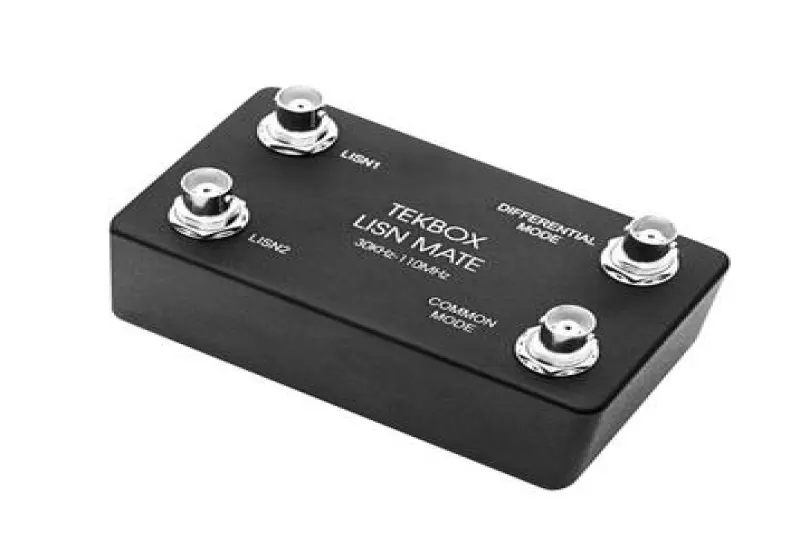
The LISN Mate separation network solves that limitation: it breaks the measured signal down into its two components and allows a clearer analysis.
Differentiating modes in EMC
Noise behavior depends on how it travels through the system:
- Differential mode appears between active conductors and is usually related to the internal operation of the circuit.
- Common mode couples to ground or nearby structures and is a frequent source of radiated emissions.
Telling them apart makes it possible to apply specific solutions: redesigning current paths, selecting filters or improving shielding.
How it operates
The LISN Mate is used together with two LISNs installed on the power lines of the equipment under test:
- One LISN connected to the positive line
- Another LISN connected to the negative line
The device processes both signals and separates them into:
- Common mode signal
- Differential mode signal
Each component leaves through an independent BNC output, for direct connection to instruments such as spectrum analyzers.
Value in debugging
- Quickly identifies the predominant type of interference.
- Reduces the number of iterations in corrective testing.
- Improves the selection of mitigation strategies.
- Makes it easier to comply with regulatory limits.
It is especially useful in product development and in pre-certification processes.
Compatibility with test systems
It integrates into standard conducted emissions measurement setups. It can be used with:
- Line LISNs
- Spectrum analyzers
- EMI receivers
- RF acquisition systems
It does not change the base measurement method: it extends the system’s analysis capability.
LISN Mate technical specifications
| Parameter | Specification |
|---|---|
| Frequency range | 30 kHz – 110 MHz |
| Maximum RF level (per port) | 27 dBm |
| Maximum DC current | 30 mA |
| Connection type | Independent BNC |
| Main function | Separation of common and differential mode |
Typical applications
It is used where detailed conducted noise analysis is required:
- Development of switched-mode power supplies
- Automotive electronics
- Industrial and control equipment
- Consumer electronics
- EMC test laboratories
Benefits of renting
Renting the LISN Mate gives access to advanced analysis capabilities without acquiring it permanently:
- More precise diagnosis of noise behavior.
- Optimized engineering time.
- Greater effectiveness when implementing solutions.
- Simple integration into existing test benches.
- Lower costs in validation projects.
This way, conducted emissions problems are addressed with more clarity and the likelihood of regulatory compliance improves from the early stages of development.