


Why measure insulation in lithium batteries
We perform specialized tests on lithium batteries because they require very high levels of insulation to maintain safety and stability and to avoid internal short circuits or dangerous leakage. Modules, cells, insulators, separators, gaskets, busbars and connectors are subjected to heat, vibration, humidity, electrostatic discharges and electric field gradients far greater than those of a conventional automobile.
For this reason, low-voltage resistance meters (1–5 V) are not suitable for validating insulation in battery systems. Measurements at 50, 100 V or more are needed, depending on the pack design.
Our meters
Our special meters are supermegohmmeters capable of measuring up to 100 V. We also have meters with capacities of up to 10,000 volts. This allows a detailed analysis of the insulation of critical lithium battery components at voltages closer to real operation.
Why measure at 50–100 V or more
Lithium cells work between 3.2–4.2 V, but the complete pack can have voltages of 50–800 V depending on the application. In these systems:
- Microscopic moisture causes leakage that appears only at elevated voltages.
- Polymer insulators degrade thermally or through cycling.
- Separator films change their resistivity under electrical stress.
- Microcracks in encapsulation are not detected by low-voltage measurements.
Measuring only at 1–5 V gives unrealistic values that can put the integrity of the pack at risk.
100 V applications for battery systems
1. Insulation testing on modules and packs
Detects leakage between enclosure, busbars, terminals and cells.
2. Insulation of separators and ceramic coatings
Many separators show voltage-dependent conductivity.
3. External protective polymers (enclosures, supports, covers)
Heat from the pack deteriorates resistivity; measuring at 50–100 V reveals it.
4. High-voltage (HV) connectors
Safety standards call for insulation levels evaluated at elevated voltages.
5. ESD coatings and dissipative materials
Non-linear behavior is detected only when the voltage is increased.
Accessories for high resistance
We have the right accessories for measuring high resistance:
- Insulation resistance
- Volume resistance
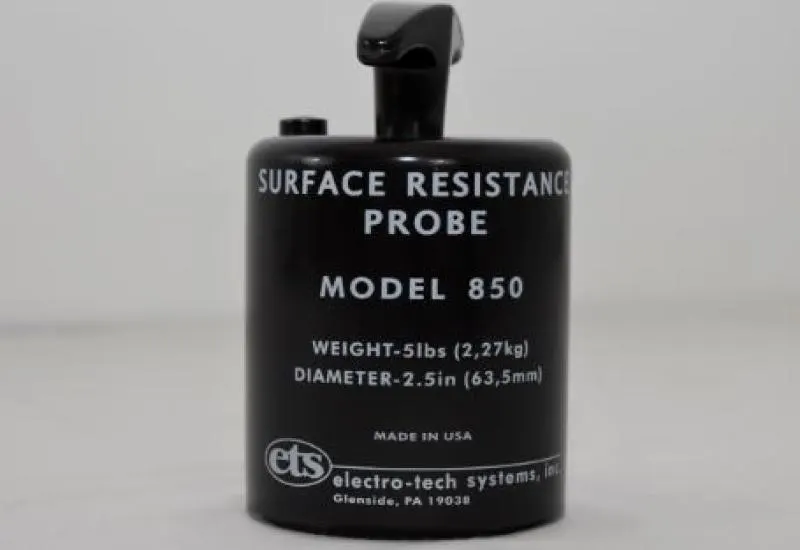
- Surface resistance
- Surface resistivity
- Volume resistivity
- Leakage and minimal currents in uA