


Scope of the power quality analysis
The basic power quality analysis covers the following points.
1. Preliminary analysis
The background of all problems attributed to poor electrical power quality is reviewed with the users.
2. Visual inspection of electrical integrity
A visual inspection is carried out and information is gathered on the electrical installation and the affected equipment. A printed copy of the national electrical code is taken along to verify the grounding and lightning protection installations and to record possible code violations. It is an in-depth inspection of the internal wiring.
The results and the conditions found are recorded in a report. Where applicable, recommendations are issued for any observed damage, deterioration or defect that could give rise to a correctable hazard, so that the installation can continue to be used safely.
The visual inspection is a necessary component of infrared inspections; the two go hand in hand. Its purpose is to find electrical problems so that maintenance staff can repair them before they fail or damage the component, with the resulting downtime.
Some critical problems are obvious and others are not without due diligence. The visual inspection can be as important as infrared for the safety of personnel and equipment: there are many things that infrared does not detect.
The visual inspection may seem to go beyond what a thermographer is hired to do, but conscientious thermographers include notes and images in their reports when they see NEC violations, broken equipment, incorrectly sized fuses, incorrect wiring and so on.
3. Infrared thermography analysis
Faults in electrical systems show up as hot spots. They are often the result of increased resistance in a circuit, overloads or insulation failures. Thermography makes it possible to obtain results without interrupting the operating system.
Electrical breakdowns are inconvenient and costly. Today, maximizing uptime and maintaining assets is a primary requirement in complex process systems. Even a short-term loss of production can translate into commercial losses.
Thermography helps identify the fault before the breakdown occurs. The problem can then be resolved as part of planned maintenance, before it becomes serious. In the analysis, high-resolution thermographic images are taken of the transformers, electrical panels and load connections.
In electrical panels, overheating can be due to:
- Loose or deteriorated connections caused by lack of proper torque, oxidation, sulfation or electric arcs.
- Conductor overloads from loads too high for the wire gauge.
- Nearly open circuits that develop resistance.
- Imbalance and unbalance in three-phase loads.
- Inductive heating (generally transformers and motors).
- Harmonics.
Thermography equipment: Flir E8 high-resolution thermal imaging camera with (patented) MSX technology.
4. Measurement of electrical quality parameters
Field measurements are carried out in the following stages.
Neutral and ground
- Measurement of the neutral and ground conductor.
- Potential difference between neutral and ground.
Electrical parameters
- Per-phase and three-phase voltage.
- Per-phase and three-phase current.
- Per-phase and three-phase power factor.
- Displacement power factor.
- Per-phase and three-phase active power.
- Per-phase and three-phase apparent power.
- Per-phase and three-phase reactive power.
Harmonics
- Total harmonic distortion in voltage and current per phase.
- Harmonic content in voltage and current up to the 50th harmonic on each phase.
- Total harmonic distortion in the neutral and ground conductors.
- Individual harmonic distortion up to the 50th harmonic in the neutral and ground conductors.
Transients
Voltage and current transients are measured simultaneously on all phases. All transient events are captured with a minimum resolution of ½ cycle, with simultaneous recording of each phase.
- Minimum, average and maximum voltage profile.
- Overvoltages and voltage drops.
- Sags.
- Swells.
- Impulses.
- Micro-interruptions.
All measurements are made under normal load conditions. Equipment: Fluke model 435 II power quality analyzer (Class A).
Report
A professional report is delivered with the following points:
- Objective of the study.
- Methodology used to prepare the report.
- Development of the study, with the measurement results in tables and graphs:
- Voltage and current waveforms per phase.
- Table and graph of total harmonic distortion in voltage and current.
- Tables and graphs of individual distortion up to the 50th harmonic in voltage and current.
- Table of overcurrent generated by harmonics.
- Table of distribution equipment losses due to harmonics.
- Table and graph of the behavior of electrical parameters over time (voltage, current, power factor, active, reactive and apparent power).
- Table of voltage and current unbalance percentage.
- Table of voltage regulation percentage.
- Load flow graphs.
- Graph and table of the transients that occurred.
- Table of events with type, time of occurrence, duration and magnitude (sags, swells, impulses, micro-interruptions).
- Voltage and current profile tables.
- Current, voltage and harmonic levels in the neutral and ground conductor.
- Final conclusions and recommendations:
- Current power factor situation and recommendations for optimizing it.
- Effect of harmonics on the system.
- Effect of transients on your system.
- Problems detected from other causes, such as overvoltage and unbalance.
- Analysis of the results against the main national and international standards.
- Solutions for each problem detected, with recommendations and suggestions for the necessary equipment.
Extras
At the customer’s request, flicker, inrush currents, energy loss calculations and inverter efficiency can be reviewed.
What causes harmonics?
AC electrical loads are called linear or non-linear, depending on how they draw current from the waveform of the main power supply. In a linear load, the voltage and current waveforms are sinusoidal and the current at any moment is proportional to the voltage; this is known as Ohm’s law. Examples of linear loads: transformers, motors and capacitors.
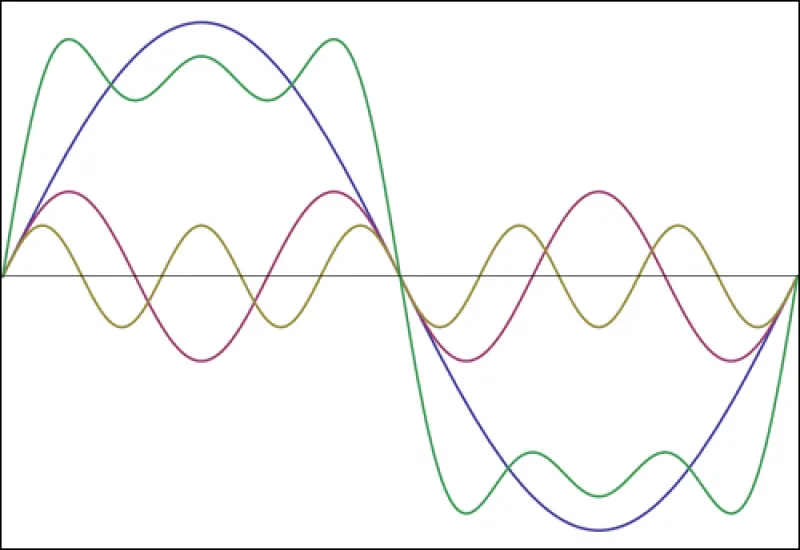
In a non-linear load, the current is not proportional to the voltage and fluctuates according to the impedance of the alternating load, so the current it draws does not have the same waveform as the supply voltage. Non-linear loads draw current in short, abrupt pulses. These pulses distort the current waveforms and generate harmonics, which can cause power problems in the distribution system equipment and in the loads connected to it. Examples of non-linear loads: rectifiers, variable speed drives and electronic devices such as computers, printers, televisions, servers and telecommunications systems that use switched-mode power supplies (SMPS).
What are the consequences of harmonics?
The ability of a power system to operate at optimum levels is compromised when harmonic distortion enters it. Harmonics create inefficiencies in equipment operation because of the greater need for energy consumption. The increase in total current required raises installation and energy costs, causes overheating and reduces the profitability of electrical systems.
How can harmonics be reduced?
Some of the most common ways to control them:
- Reduce the harmonic currents produced by the load. Adding a line reactor or a series transformer significantly reduces harmonics and also protects against transients.
- Add filters that divert harmonic currents from the system, or that supply them locally. For example, a shunt filter installed as close to the source as practical short-circuits the harmonic currents and keeps them out of the supply system. It is a good option because it is cost-effective and can correct the power factor of the load by eliminating the harmonic current.
- Modify the frequency response of the system with filters, inductors or capacitors. Active filters work by electronically supplying the harmonic component of the current of a non-linear load.
- Make transformer connections that reduce harmonic currents in three-phase systems.
- Change the capacitor size. This is usually one of the least costly options, for both utilities and industrial customers.
Do you have problems with harmonics? Write to us on WhatsApp at 8117860768.