


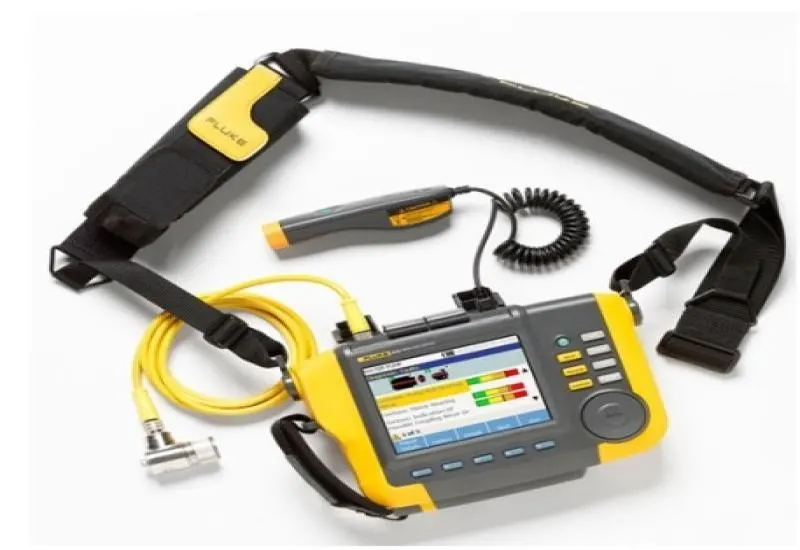
Vibration in rotating equipment in Monterrey
Vibration analysis is the process of measuring the vibration levels and frequencies of industrial machinery and using that information to determine the “health” of the machine and its components. Predictive maintenance monitors the performance and condition of equipment while it works normally in a production process, to reduce the likelihood of failures. For motor maintenance we have the Fluke 810 vibration analyzer.
Industrial vibration analysis is used to identify, predict and prevent failures in rotating machines. It improves machine reliability and efficiency and reduces downtime. It is used in industry around the world to identify faults, plan repairs and keep machinery running as long as possible without failures.
How vibration is measured
When an industrial machine (such as a fan or a pump) operates, it generates vibration. This is measured with an accelerometer, which generates a voltage signal proportional to the amount of vibration and to its frequency, that is, how many times per second or per minute it occurs. This signal is connected to a data collector, which records it as a time waveform (amplitude vs. time), as a Fast Fourier Transform (amplitude vs. frequency), or both. A trained vibration analyst, or a software algorithm, can analyze the signal.
The method is nothing new. The piezoelectric effect and the charge output of certain materials were discovered in 1880 by the Curies. The first accelerometer entered industry in 1923. Over the last 100 years the technology has evolved to offer fast, efficient measurements of machinery vibration. The sensors are designed to withstand harsh industrial environments and deliver critical measurements year after year.
Why vibration analysis is applied
The analyzed data is used to determine the “health” of the machine and identify impending problems, such as misalignment, unbalance, bearing or lubrication problems and deformed parts, among others. Vibration is a harmonic motion of very small amplitude that is usually detected on a housing or a machine shaft.
For example, if one of the blades is removed from an industrial fan and the fan is started, it will vibrate because of the unbalanced wheel. That unbalance force occurs 1 time/revolution of the fan. If the blade is reinstalled, the vibration decreases.
Vibration analysis can determine problems caused by incorrect installation, machining errors, insufficient lubrication, incorrect shaft or pulley alignment, loose bolts, bent shafts and many more.
In most cases it detects these problems long before the maintenance technician sees the damage and before it damages other machine components. Vibration analysis, condition monitoring and predictive maintenance have increased the service life of machinery.
Faults identified by vibration analysis
There are several characteristic faults in machine rotation that are identified by measuring and analyzing the vibration they generate:
- Unbalanced machine
- Misaligned machine
- Resonance
- Bent shafts
- Gear mesh disturbances
- Poor condition of plain and rolling bearings
- Blade pass disturbances
- Vane pass disturbances
- Proper equipment mounting
- Electromagnetic faults
- Recirculation and cavitation
- Motor faults (rotor and stator)
- Rolling bearing faults
- Mechanical looseness
- Critical machine speeds
- Lubricant condition