


What ESD testing is
ESD is only a slight annoyance for people, but a challenge for electronics: the rapid rise in voltage and current can cause serious damage. Static charge builds up, for example, on a person and then discharges into a computer. It is most commonly created by the contact and separation of two materials.
ESD testing determines the durability of electronic devices when a person touches them and a discharge occurs. It is performed with portable, lightweight electrostatic discharge simulators, also known as ESD guns, for example the LISUN electrostatic discharge simulator.
ESD testing is part of electromagnetic compatibility testing (EMC, also called CEM testing). It simulates the electrostatic impacts the equipment may encounter in transit or in operation, and determines whether a product’s ESD procedures and protection area are being followed.
Charge buildup can occur on humans, machines or objects, which is common in industrial and manufacturing processes. The rapid discharge of energy generates voltage and current, which are used to define (along with other criteria) what constitutes an ESD event for immunity testing.
Objective and scope
ESD testing focuses on the impact the operating environment can have on the equipment under test (EUT). The objective is to verify immunity: that the performance or functionality of the equipment does not change through exposure to electrostatic discharge events.
Testing is performed at component or device level and at system level, depending on the equipment.
Test methods
The two most common methods for testing the EUT’s ability to withstand an ESD event are contact discharge and air discharge. Both are usually referenced by different standards, and contact discharge is often preferred. Test levels are usually different; air discharge is usually the higher for commercial applications, at 16 kV. Different tips are used for each method.
Air discharge
It is commonly used to replicate real events and when contact discharge is not possible. It simulates real-world events more accurately, since most discharges occur from objects moving or separating.
It requires a rounded tip to facilitate arcing across the air gap. These tips are usually designed in accordance with IEC 61000-4-2, which imposes design requirements. Factors that can affect the test include:
- Humidity: the lower the humidity, the greater the likelihood of an electrostatic discharge.
- Temperature: the lower the temperature, the more often ESD events tend to increase.
- Approach speed: try to duplicate the recommended speed to ensure compliance.
Contact discharge
This is the preferred method for a variety of ESD test requirements, including IEC 61000-4-2, because it helps limit test uncertainties. It gives more repeatable results, although it does not simulate as faithfully how ESD events occur.
ESD pulses include current and voltage components, with current waveform criteria (rise time, duration, etc.) verified against a particular standard.
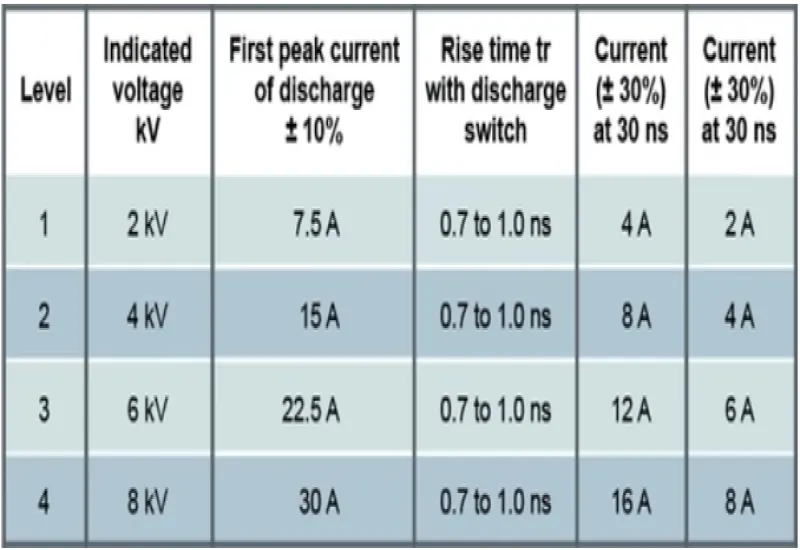
The image shows the correlation between the various test levels and the associated voltages and currents, up to 8 kV or test level 4.
ESD current waveform
The current waveform is an important component for meeting test standards or requirements. The most common commercial standard, IEC 61000-4-2, specifies a rise time of 0.8 ns and current requirements at 60 ns and 30 ns for contact discharge.
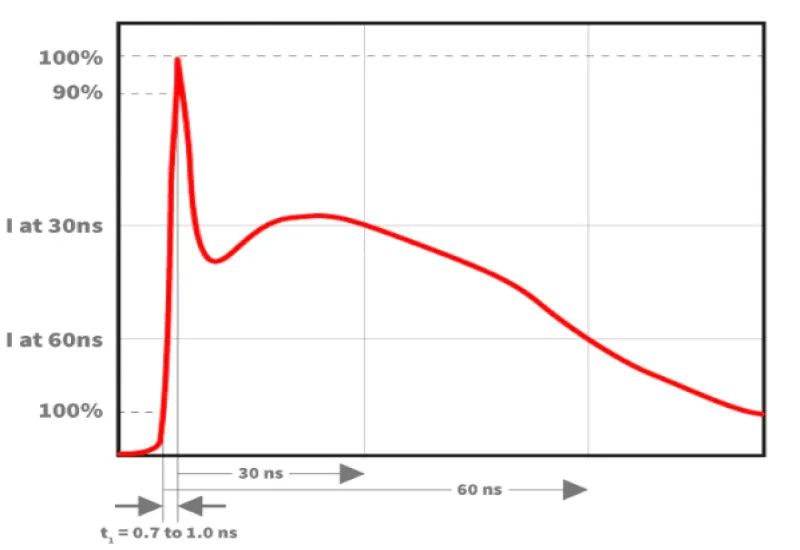
The image shows a pulse taken from the user manual, with typical rise time and current requirements at different intervals. Each application or standard may have different pulse requirements, so it is crucial to verify capabilities before starting testing.
ESD tabletop setup
The ESD tabletop setup is the most widely used. The diagram is generic: it does not give exact information, but it shows the setup and the main components. It is designed for EUTs that can be placed on insulating material. Common components:
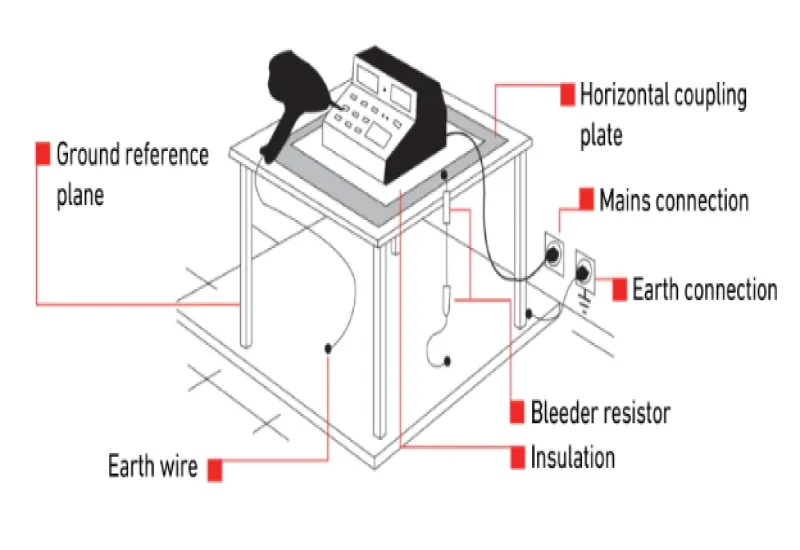
- Horizontal coupling plane (HCP)
- Insulation placed under the EUT
- All-wood table
- Bleed wiring, including the resistors
- Ground reference plane