


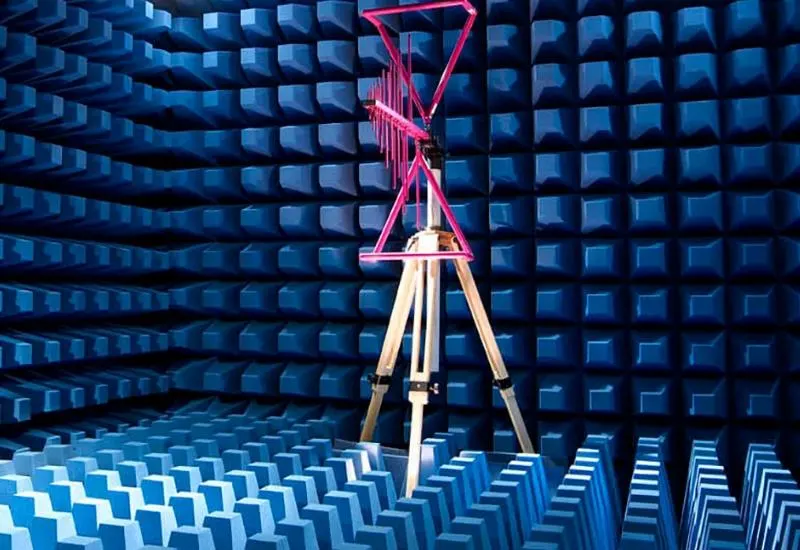
EMC EMI electromagnetic compatibility and interference testing (precompliance)
We analyze products and designs and their electromagnetic environment (precompliance) with electrical and electronic tests, based on current standards and regulations and using only professional-brand equipment. Use our service before taking your product to an electromagnetic compatibility laboratory. We measure conducted emissions with a LISN (Line Impedance Stabilization Network) and emissions with probes, special antennas and spectrum analyzers. We also rent equipment so that you can perform the tests yourself.
Open laboratory
You can visit us and watch the analyses live, or we can record the work procedures on video. We use a LISN to remove harmonics from AC lines and obtain accurate measurements of the equipment under test.
Why test for EMI and EMC
Whether your product is for military, industrial, commercial or residential use, it must perform its function in its electromagnetic environment, and EMI/EMC testing verifies this. In addition, its operation must not harm other systems. This requirement may be voluntary, imposed by the customer or set by regulation.
Compatibility (EMC) testing requires appropriate electrical and structural design, equipment installation, cabling installation and qualification equipment. Interference (EMI) testing ensures that the product works correctly in the electromagnetic environment where it will operate.
Each system must be compatible with itself, with other systems and with the external environment, in order to achieve the desired performance and avoid costly redesigns.
- Effects external to the system: lightning, electromagnetic pulse (EMP), electrostatic discharge and man-made RF transmissions.
- Effects internal to the system: electronic noise emissions, self-generated RF transmissions from antennas and cross-coupling of electrical currents.
Whether your project is in design, development, precompliance or qualification, we can support your EMI/EMC testing with engineers and technicians. Contact us to learn about our EMI test methods, EMC tests and electrical conductivity and near field tests.
What EMI is
Electromagnetic interference occurs when one electronic device adversely affects the operation of another. Any electrical or electronic device can interfere with another because of the physical laws of radio waves.
As they move, electrons create electromagnetic waves that propagate through free space and interact with each other. Switching power supplies, motor controllers, computers, cell phones and many other devices can cause interference.
A familiar example: a vacuum cleaner near a television with an antenna. The motor generates broadband electromagnetic noise over a wide frequency spectrum, and the picture becomes distorted.
What EMC is
Electromagnetic compatibility (EMC) is essentially the opposite of EMI. It means that the device is compatible with its electromagnetic environment and does not emit energy levels that interfere with other nearby devices.
In the military field, EMC refers to compatibility between internal systems. For example, with all the systems of an aircraft in operation, each one must perform its function without interfering with the others or being interfered with.
In the laboratory, the ability of equipment to withstand electromagnetic interference is verified by subjecting it to electromagnetic energy. These tests can be conducted or radiated. The military field calls them susceptibility tests and the commercial field calls them immunity tests; it is the same thing seen from a different perspective.
Emissions measurement
Electromagnetic emissions from the equipment under test (EUT) are received with a sensor or an antenna placed near the equipment. Frequency versus amplitude is normally measured, although other types of measurement are possible. Different sensors are used depending on the specification and the type of measurement (loop sensor, vertical monopole antenna, linearly polarized antennas, etc.). Each specification describes the measurement parameters and the limits for the measured emissions.