


Electrical and electronic analysis and testing courses
We teach electronics courses in Monterrey. The method is interactive between students and instructor: what matters is what you understand, not just what you know. We emphasize electrical fundamentals before any course. We train on all types of laboratory electronic analysis equipment.
We rent out electronic analysis, measurement and test equipment, including:
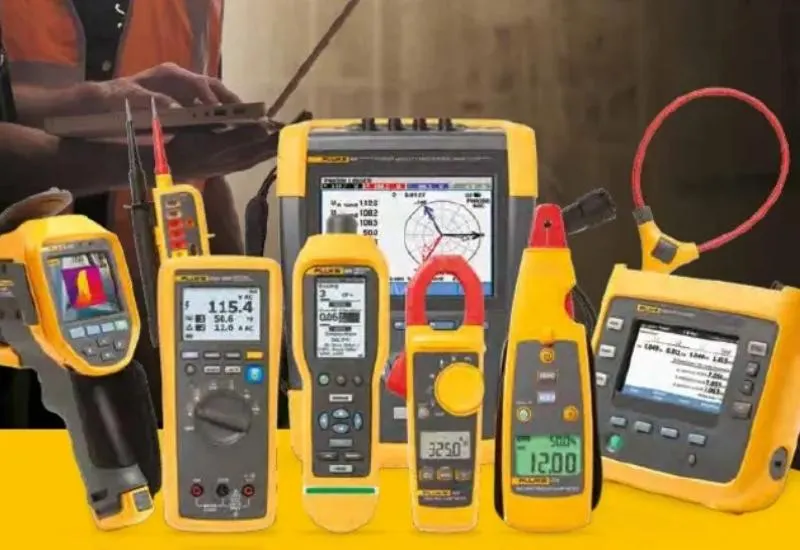
- Fluke 434, 435 II and 43B three-phase analyzers
- Anritsu signal generators
- HP spectrum analyzers
- Agilent FieldFox RF analyzers
- Tektronix oscilloscopes
- Hioki, BK Precision, GW Instek, Lecroy, Kikusui
- Array electronic loads
- Exfo optical meters
- Hitesters
- Programmable power supplies, signal generators and sweep generators
We offer training and repair. We also perform frequency sweeps and interference analysis in every state of México.
Training, equipment rental and sales
We rent and lease out equipment, and we teach electronics classes in Monterrey covering the full use of analysis and measurement equipment, in a one-on-one format (One on One). With this hands-on training you work with the real equipment. We also sell electronic measurement equipment from brands such as Agilent, Fluke, Tektronix, HP, Owon, Anritsu, Yokogawa, Rigol, Lecroy and Keithley.
Equipment we work with:
- Spectrum analyzers
- Oscilloscopes
- Signal generators, including arbitrary generators
- Dynamic signal analyzers
- Vector signal analyzers (VSA)
- Graphical multimeters
- RF vector network analyzers
- RF power meters
- Service monitors
- OTDRs and fiber optic equipment
- Vibration analyzers
- Programmable power supplies
- Thermal imaging cameras
Other services
Frequency sweeps and RF measurements
We perform frequency sweeps to detect interference and free channels, as well as spectrograms and optical analysis. We characterize cables, antennas, attenuators, filters, amplifiers and couplers. We inspect cabling installations and measure power and other parameters.
Vibration checks
We measure vibration for the maintenance of industrial motors, turbines and rotating shafts, in order to align them and correct unbalance and looseness in:
- Motors, fans, drive belts and drive chains
- Gearboxes and gears
- Centrifugal, piston, sliding-vane, screw, thread and lobe-gear pumps
- Piston, centrifugal and screw compressors
- Close-coupled machines, spindles, etc.
We produce professional reports from the data obtained.
Interference analysis and frequency sweeps in México
In México, interference problems are growing because more radio systems are being deployed. Transmitters are installed closer to one another and more power is generated in cables and antennas, so the probability of interference increases every year. We have the equipment to locate the interference source quickly and safely, and we produce professional reports with the acquired data.
Single-phase and three-phase power quality analysis
We rent out electrical power equipment such as the Fluke 435 II or the Fluke 43B in Monterrey. It is a three-phase power quality (PQ) meter with an energy loss calculation function and unified power measurement (UPM). It allows you to:
- Detect and resolve problems at the first-response level.
- Carry out predictive maintenance, long-term analysis and load studies.
- Capture the event waveform.
- Measure flicker and transients.
- Perform mains signaling measurements and obtain power waveforms.
- Obtain power inverter efficiency.
Includes i430flex-TF clamps. Model Fluke 435-II.
The rental can include a technician experienced with the equipment. This saves you time and cost, and avoids the purchasing and training process. It also lets you see how the equipment performs in the field before you buy it.
We sell instrumentation and analysis equipment, and we offer training and instruction.
Videos and tutorials
Some of our YouTube videos:
www.youtube.com/user/electronicatutorial
Electronics: DIACs and TRIACs, how to build a dimmer
http://www.youtube.com/watch?v=GWUqOnb7UAA
We explain what DIACs, TRIACs and thyristors are, and how to build a dimmer circuit with a TRIAC.
The DIAC (Diode for Alternating Current) is a two-terminal semiconductor device. It is a bidirectional trigger diode that conducts only after its breakover voltage is exceeded, and as long as the current does not fall below the device’s characteristic value. It behaves the same in both current directions. Most DIACs have a breakover voltage of around 30 V. The TRIAC (Triode for Alternating Current) is a semiconductor of the transistor family. Unlike a conventional thyristor, which is unidirectional, the TRIAC is bidirectional: it is a switch capable of switching alternating current.
Reactance, inductance (henrys), farads and resonance on an RF network analyzer
http://www.youtube.com/watch?v=DH3WYKDu8CY
We review the reactances of an inductor and a capacitor on an RF vector network analyzer.
Inductance (L) measures the opposition to a change of current in an inductor or coil, which stores energy in the presence of a magnetic field.
Oscilloscope current probes and 1X and 10X passive probes
http://www.youtube.com/watch?v=7mRzAGUIWpg
Limitations of passive probes, with examples of current clamps for the oscilloscope.
The oscilloscope is a device for graphically displaying electrical signals that vary over time. The vertical axis (Y) represents voltage and the horizontal axis (X) represents time.
What we can do with an oscilloscope
- Determine the period and voltage of a signal directly.
- Determine the frequency of a signal indirectly.
- Determine which part of the signal is DC and which is AC.
- Locate faults in a circuit.
- Measure the phase between two signals.
- Determine which part of the signal is noise and how it varies over time.
- Measure the rise and fall times of a signal.
- Perform numerous mathematical measurements on any signal.
Lissajous figures and video on an oscilloscope in XY and XYZ mode
http://www.youtube.com/watch?v=V29LAoFBmoY
We look at figures and patterns, and video, with the oscilloscope in XY and XYZ mode.
Sensors convert physical forces into electrical signals that can be observed and studied with an oscilloscope. It allows engineers, technicians and educators to "see" events that change over time, and it is a fundamental tool in the design, manufacture and repair of electronic equipment.
Power factor, impedance, capacitive and inductive reactance, real power
http://www.youtube.com/watch?v=BrVxGd2we7M
What power factor (PF), impedance and reactance are, with an experiment that shows the difference between real power and apparent power.
Reactance is the opposition to the flow of alternating current presented by inductors (coils) and capacitors. It is measured in ohms. Together with resistance it determines the total impedance (Z): reactance (X) is the imaginary part and resistance (R) is the real part.
4QAM or QPSK digital modulation: vector and constellation diagrams on an oscilloscope
http://www.youtube.com/watch?v=nHN7PbWVh1A
Phase shift keying (PSK) is an angle modulation that varies the phase of the carrier between discrete values. Unlike conventional phase modulation (PM), where the variation is continuous, in PSK the modulating signal is digital and has a limited number of states.
Vector network analyzer: antenna reflection at different frequencies on a Smith chart
http://www.youtube.com/watch?v=HSlNw2u4EiI
A network analyzer analyzes the properties of electrical networks, known as scattering parameters (S-parameters). It is used most often at high frequencies, between 9 kHz and 110 GHz.
Tutorial: oscilloscope trigger controls
http://www.youtube.com/watch?v=ePwBO26ILvU
When the probe receives a signal, a circuit tells the oscilloscope to start plotting it on the screen. When the trace reaches the right edge of the screen, the oscilloscope presents it again.
Tutorial: using the spectrum analyzer and safety measures
http://www.youtube.com/watch?v=lSlcrhdVuM8
A spectrum analyzer is a measuring instrument that displays on screen the spectral components of input signals, whether electrical, acoustic or optical.
Digital and analog oscilloscopes: AC, DC and GND vertical coupling
http://www.youtube.com/watch?v=WFefIMt-ITo
Video on AC, DC and GND coupling in the vertical section of an analog and a digital oscilloscope. We show how to make differential measurements with the two channels without GND connected, and an AC signal on top of the DC of a power supply.
Tutorial: basic function generator on an analog oscilloscope
http://www.youtube.com/watch?v=crht62TT4K0
A signal, function or waveform generator is a laboratory device that generates periodic or non-periodic, analog or digital signals. It is used in the design, testing and repair of electronic devices.
Tutorial: analog oscilloscope, measuring rising and falling edges
We use cursors and delayed sweep to measure the rising and falling edges of a square wave.
The oscilloscope measures voltage directly. Other quantities, such as current or power, are obtained by calculation from the voltage.