


Dielectric characterization of liquids from low frequency to radio frequency
The electrical properties of a liquid are fundamental for designing, developing and controlling the quality of materials used in the electrical, electronics, automotive, medical, chemical, aerospace and telecommunications industries.
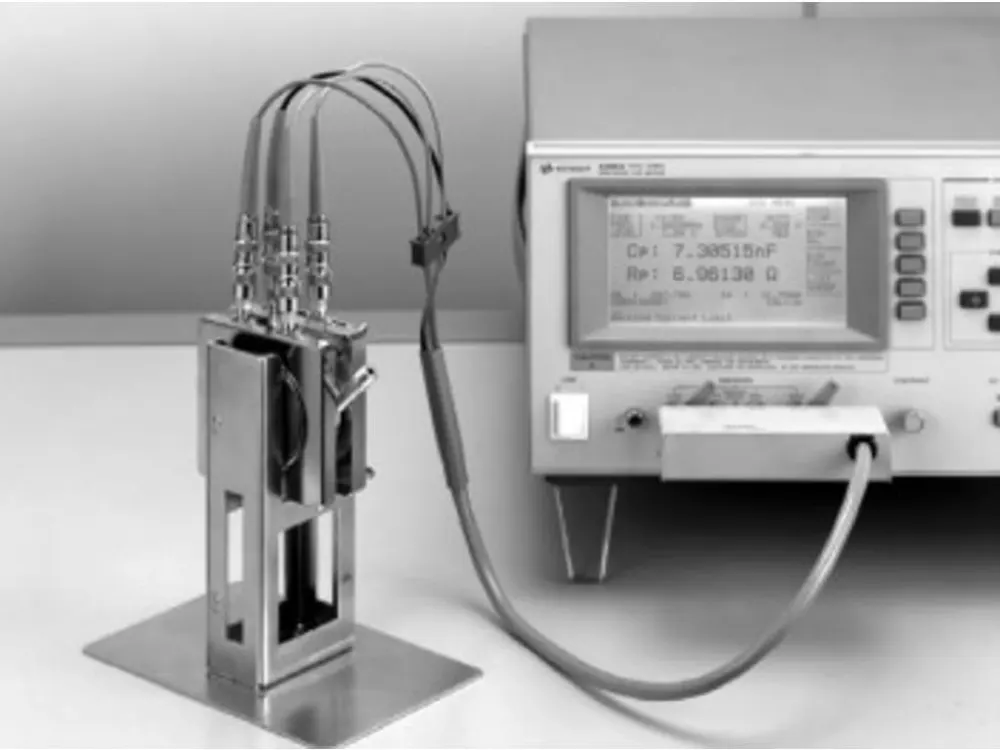
At Electrónica Monterrey we perform electrical and dielectric characterization of liquids with Keysight Technologies and Keithley instrumentation. We use specialized liquid fixtures that deliver reliable measurements from low frequencies up to microwaves.
Our laboratory evaluates dielectric oils, lubricating oils, fuels, coolants, solvents, liquid resins, polymers, insulating liquids, conductive liquids and special materials for research and development.
What is dielectric characterization of liquids?
It consists of determining how a liquid responds when an electric field is applied to it. Each liquid has its own electrical signature, which is used for:
- Material identification.
- Development of new products.
- Scientific research.
- Quality control.
- Contamination diagnosis.
- Aging evaluation.
- Sensor design.
- Electromagnetic modeling.
- RF and microwave simulation.
Properties we measure
Relative permittivity (dielectric constant, εr)
Indicates the ability of the liquid to store electrical energy within an electric field. It is indispensable for capacitive sensor design, electromagnetic simulation, the design of immersed antennas, RF engineering, power electronics and insulating materials.
Dissipation factor (tan delta)
Tan delta represents the dielectric losses of the liquid. It reveals:
- Insulation quality.
- Contamination.
- Moisture.
- Aging.
- Molecular polarization.
- Behavior versus frequency.
It is one of the most widely used parameters for evaluating dielectric liquids and insulating materials.
Volume resistivity
We determine the ability of the liquid to oppose the flow of electric current. It applies to dielectric oils, coolants, hydraulic fluids, insulating liquids and high-purity materials.
Electrical conductivity
Indicates the amount of electric charge a liquid can carry. It is used for ultrapure water, chemical solutions, electrolytes, coolants, industrial liquids and chemical processes.
Complex impedance
We measure the complex impedance of the liquid as a function of frequency. This makes it possible to study polarization, conductivity, dielectric phenomena, liquid-electrode interfaces and equivalent models.
Capacitance
Used in sensor development, research, materials characterization, aging studies and industrial processes.
Electrical resistance
Measured with Keithley electrometers and systems for very high-resistance materials.
Complex permittivity
We obtain the real part (ε’) and the imaginary part (ε″). Together they describe the electromagnetic behavior of the liquid.
Permeability (where applicable)
For special materials, the magnetic response can also be determined when the sample type allows it.
Measurement as a function of frequency
We characterize liquids over a wide frequency range to observe how their dielectric properties change. This makes it possible to study:
- Dielectric relaxation.
- Molecular polarization.
- Dispersion phenomena.
- RF behavior.
- Microwave applications.
- Electronic device design.
Instrumentation
- Keysight LCR analyzers.
- Keysight materials analyzers.
- Keithley electrometers and precision sources.
- Automatic impedance measurement systems.
- Software for data acquisition, processing and analysis.
- Liquid fixtures of different geometries and capacities.
- Probes for high-frequency measurements.
- Calibration and metrological verification accessories.
Liquids we characterize
- Dielectric oils
- Lubricating oils
- Synthetic oils
- Mineral oils
- Fuels
- Biodiesel
- Coolants
- Solvents
- Alcohols
- Liquid resins
- Adhesives
- Liquid polymers
- Industrial inks
- Hydraulic fluids
- Emulsions
- Nanofluids
- Research liquids
- Special materials
Who uses the service
Companies and organizations engaged in:
- Transformer manufacturing.
- Automotive industry.
- Electronics.
- Telecommunications.
- Research and development (R&D).
- Universities and research centers.
- Aerospace industry.
- Oil and gas.
- Energy.
- Advanced manufacturing.
- Materials laboratories.
We also serve the electrical, petrochemical, chemical and biomedical sectors, materials manufacturers and technology innovation companies.
Benefits
- Metrological precision.
- Repeatable results.
- Wide frequency range.
- Measurement of multiple electrical parameters.
- Support for research and development.
- Development of advanced materials.
- Reverse engineering and materials validation.
- Complete technical reports.
Why choose Electrónica Monterrey
Our infrastructure combines Keysight and Keithley instrumentation, materials analysis software and a wide variety of liquid fixtures. This lets us adapt the measurement to different sample types and frequency ranges.
Our technical team supports research projects and industrial applications, with results that facilitate product design, quality control and analysis of the electromagnetic behavior of liquid materials.