


Diagnosing insulating oil condition in accordance with ASTM standards
Dielectric oil is one of the most important components in the operation of transformers, circuit breakers, reactors and other electrical power equipment. Besides providing electrical insulation, it acts as a cooling medium and protects the internal insulating materials against aging.
Over time, the oil degrades through oxidation, moisture, contamination, high temperatures and electrical stress. It loses insulating capacity and the risk of serious failures increases.
We perform a complete physicochemical analysis of dielectric oils. With it, you learn the actual condition of the oil, determine its service life and establish predictive maintenance actions before costly failures occur.
Why perform a physicochemical analysis
Periodic analysis makes it possible to:
- Detect moisture contamination.
- Identify oxidation processes.
- Evaluate oil aging.
- Verify its dielectric capacity.
- Prevent internal discharges.
- Reduce downtime.
- Increase transformer service life.
- Avoid unnecessary oil replacement.
- Schedule maintenance based on condition rather than time.
Tests we perform
Dielectric strength, ASTM D877
Determines the ability of the oil to withstand electrical stress before a discharge occurs. It is one of the most widely used analyses for evaluating contamination by water, fibers, metal particles and other contaminants.
It is suitable for transformers, circuit breakers, new oil and in-service oil.
Dielectric strength, ASTM D1816
Uses VDE-type electrodes and is considerably more sensitive to moisture and microscopic particles than ASTM D877. For this reason it is widely used in the diagnosis of power transformers and filtered oils.
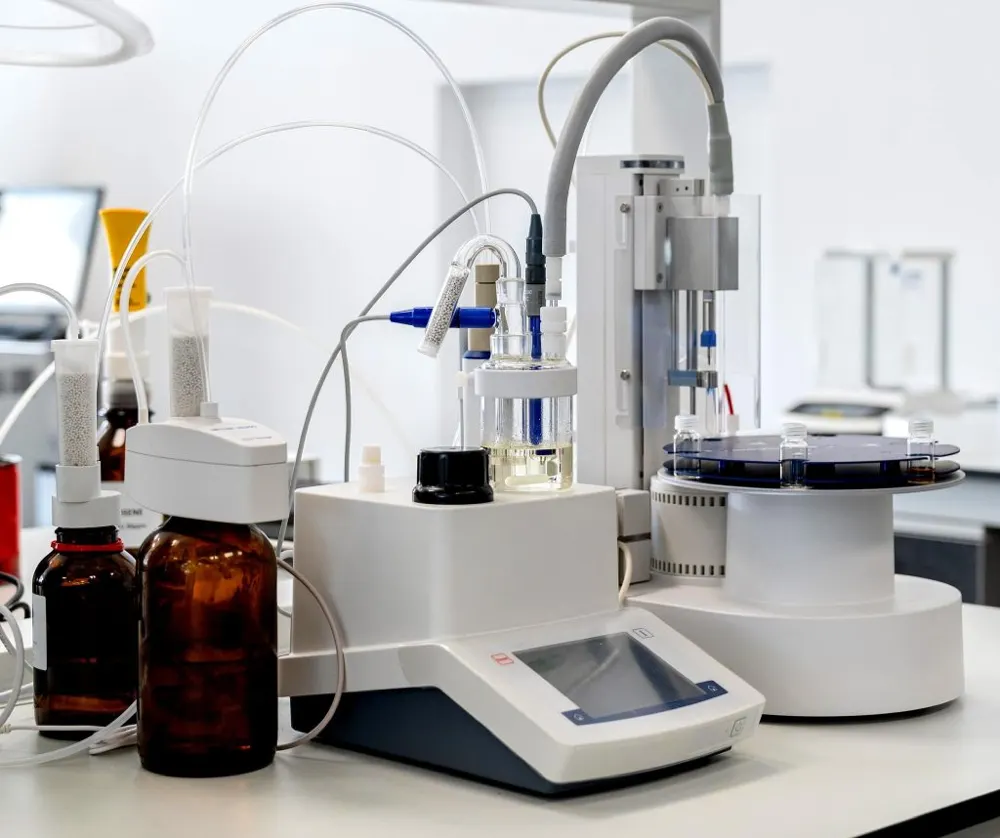
Karl Fischer moisture
Moisture is one of the main enemies of electrical insulation. Even small amounts of water reduce the dielectric strength, the life of the insulating paper and the resistance of the insulation system.
With the Karl Fischer method we obtain a precise measurement of the water content in ppm.
Power factor (tan delta)
Makes it possible to evaluate oxidation products, contamination, aging and the presence of polar compounds. It is one of the most sensitive indicators of insulating oil deterioration. ASTM D924 is one of the reference methods for this evaluation.
Electrical resistivity
Volume resistivity measures the ability of the oil to impede the flow of current. Low values may indicate contamination, oxidation, moisture or aging.
Interfacial tension
Makes it possible to identify oxidation products before they are visible with other tests. A decrease usually indicates sludge formation, oil oxidation or chemical contamination. It is one of the most important indicators of oil condition.
Viscosity
Determines the ability of the oil to circulate and dissipate heat. An increase can lead to lower cooling capacity, overheating and reduced transformer efficiency.
Density
A physical property used to verify the uniformity of the oil and detect possible contamination or changes in its composition.
Acidity (neutralization number)
An increase in the acid number indicates oxidation processes. The presence of acids promotes:
- Corrosion
- Sludge formation
- Deterioration of the insulating paper
- Reduced transformer service life
Colorimetry
A change in color is a preliminary indicator of aging and contamination. On its own it does not determine the condition of the oil, but it complements the interpretation of the other analyses.
What you get from the analysis
- Comprehensive diagnosis of the dielectric oil.
- Early detection of moisture and contamination.
- Identification of oil aging.
- Prevention of electrical failures and greater system reliability.
- Longer transformer service life and lower maintenance costs.
- A technical basis for deciding between filtering, regenerating or replacing the oil.
Applications
We analyze oils from:
- Power, distribution and generation transformers
- Oil circuit breakers
- Reactors
- On-load tap changers (OLTC)
- Industrial electrical equipment and electrical substations
- Generating plants
- Oil industry, mining, automotive sector, steel industry and data centers
Our laboratory
We have specialized instrumentation for physicochemical and electrical tests on dielectric oils, with procedures based on ASTM standards. Each sample is analyzed under controlled conditions to obtain reliable, repeatable results, in support of predictive maintenance and transformer diagnostic programs.
When analysis is recommended
- On receipt of new oil.
- Before energizing a transformer.
- After oil filtering or regeneration.
- During preventive maintenance programs.
- When there are trips or electrical failures.
- After overloads or overheating.
- As part of annual or semi-annual predictive maintenance.
Talk to the engineer to define the tests your equipment requires and make timely maintenance decisions.