


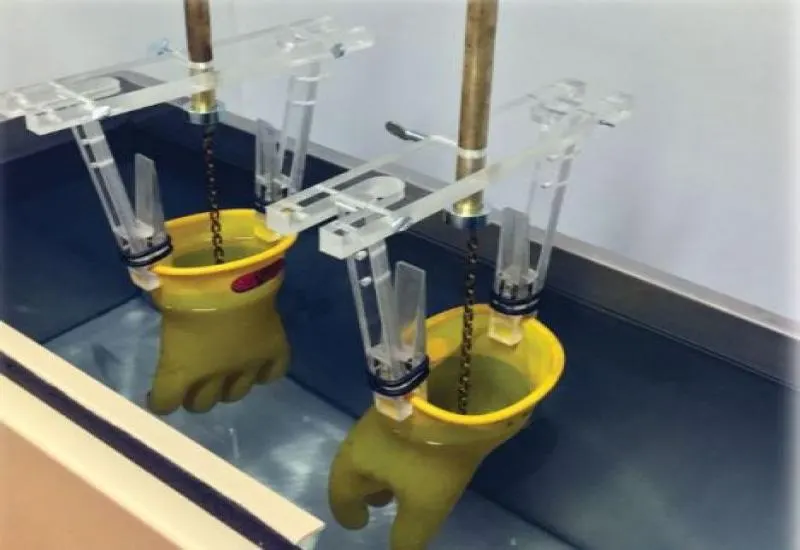
Air-tightness and leakage current testing of dielectric gloves with high-voltage hipots
As a rule, gloves are checked before use. An air-tightness test can be performed, manually or with a dedicated tester.
Dielectric gloves require a more thorough check depending on their class:
- All gloves, whatever their class, must be checked at intervals of 30-90 days.
- Class 1,2,3 and 4: even if new, they must be checked at intervals of no more than 6 months. The check consists of a visual inspection, an air-tightness inspection and a dielectric test, as indicated by the UNE EN 60903 standard.
- Classes 0 and 00: since they withstand lower voltage, they can be considered checked if a visual and air-tightness inspection is performed.
How we calibrate
We calibrate insulating dielectric gloves in accordance with the test procedure for insulating boots and gloves and with international standards. With the withstand voltage of the insulating sleeve (on the glove), the leakage current of each test item is read automatically. The entire process is completed automatically and the test data are printed automatically. This simplifies procedures, improves test speed and makes it possible to identify leakage current, power-frequency withstand voltage and other parameters more reliably.
We have the equipment to test insulating boots and electrical gloves and so protect workers. Its main features:
- Tests 6 items at the same time and reads the leakage current of each one to accurately identify non-qualifying items.
- The test cart has wheels on the bottom for easy movement.
- Large white-light display, clearly visible even in bright light.
- Simple one-click operation.
Insulating glove testing
Guide to the safe use of Class 00, 0, 1, 2, 3 and 4 electrical gloves
Improper use of rubber insulating electrical gloves can be a matter of life or death. Retest them regularly to make sure they are still electrically safe.
If you treat your rubber insulating gloves well, they can last a long time. Testing helps prevent failures that could cause electric shock if wear has affected the integrity of the surface.
Companies regularly ask for care and maintenance advice so that their gloves provide adequate, continuous electrical protection. We offer the necessary tests to verify whether your gloves are fit for service.
Electrical insulation tests for gloves
| Glove class (Class Of Gloves) | Maximum AC DC use voltage (Maximum Voltage Use) | AC Proof test voltage (Test Voltage) | AC Withstand test voltage (Test Voltage) |
|---|---|---|---|
| 00 | 500V ac | 750V dc | 2.5kV | 5kV |
| 0 | 1000V ac | 1500V dc | 5kV | 10kV |
| 1 | 7500V ac | 11250V dc | 10kV | 20kV |
| 2 | 17000V ac | 25500V dc | 20kV | 30kV |
| 3 | 26500V ac | 39750V dc | 30kV | 40kV |
| 4 | 36000V ac | 54000V dc | 40kV | 50kV |