


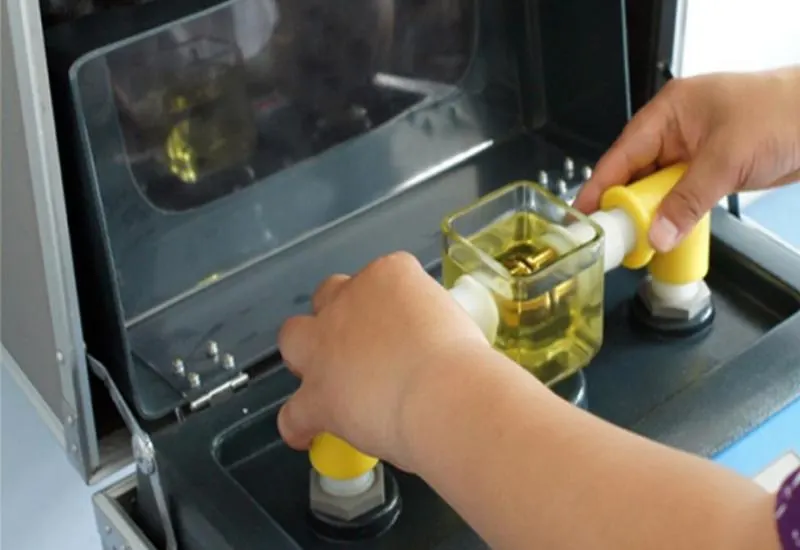
Oil testing laboratory
We analyze oil from turbines, chillers and transformers in Monterrey. We also test the density and viscosity of all types of liquids. We perform 10 physicochemical tests in the field: moisture, viscosity, resistivity, colorimetry, relative density, oil power factor and breakdown, acidity and interfacial tension. We have a complete electrical and electronics laboratory, open to the public.
We respond the same day you contact us. We constantly update our equipment and use state-of-the-art, fully automatic instruments to minimize human error.
Evidence of every test
We take live video and photographic evidence of the procedures and results for your oil, so that any professional can verify them. The customer can come, be present in the laboratory and record the tests. Our instruments print the measurements and the test date on paper, so you know that the test was done and when. We bring printed copies of the ASTM standards and the national electrical code to every job, and we prepare our reports in accordance with ASTM standards.
Tests and standards we apply
- Dielectric breakdown up to 80Kv, in the laboratory or in the field (ASTM D877 and ASTM D1816 with magnetic stirrer).
- Color with colorimeter: ASTM D1500 and D1524.
- Viscosity: ASTM D445.
- Moisture in oil with coulometric titrator: ASTM D1533 for insulating oils or ASTM D6304 for petroleum products (with double reagent).
- Resistivity: ASTM D1169.
- Power factor or dissipation: ASTM D924.
- Interfacial tension: ASTM D971.
- Acidity: ASTM D974.
Our YouTube videos: click here.
What sets us apart
- We record videos of the procedures.
- State-of-the-art, computerized equipment with touch screens.
- Internal reports generated on the instruments’ printers, with date and measurements.
- Tests performed as the standards indicate, and we keep them in print.
- Tests in the field or in front of the customer at our laboratory.
- Members of IEEE and of the electrical and dielectric associations (DEIS) for more than 10 years.
- Rental of all our equipment, also with a technician.
- Fast response: we do the analyses the same day you contact us.
- Spare machinery for comparison or immediate replacement.
- Fully automatic equipment to minimize human error.
We use only glass and stainless steel syringes and funnels to draw and handle samples directly from the transformer valve, to avoid contamination, in accordance with ASTM D3613 and IEEE Std C57 106-2006. Utensils are cleaned following the method described in ASTM D923. We buy these standards and bring printed copies to our jobs.
In all our electrical services we adhere to the internationally recognized standards of ASTM, NEC, API, ANSI NETA and NFPA. We are members of the IEEE (Institute of Electrical and Electronics Engineers) and of the DEIS (Dielectrics and Electrical Insulation Society) #94801861, which gives us access to current standards, professional forums, webinars and research material.
Field tests and customer presence
We test in front of the customer, in the field. Testing right at the transformer eliminates contamination: no condensation, agitation, temperature changes or foreign agents. Laboratory tests are supposedly done at 25 degrees, and transformers do not operate at that temperature. We recommend that you be present during your tests, to confirm that they are done as the standards indicate.
ASTM (American Society for Testing and Materials) standards have a range of 20 to 30 degrees. The way to know whether a test was done according to the standard is to ask for a video; if you cannot witness it, request one. Our printed reports are generated automatically by the dielectric breakdown and moisture content machines, which minimizes human error.
We repeat the tests 5 times, as the standard indicates, and take the average. We then calculate the standard deviation to see whether it is within the standard; if not, we repeat the tests until we obtain an optimal standard deviation and the most accurate results. We use an automatic machine to avoid errors. There are videos of the breakdown machines on our YouTube channel.
Analysis results
The analyses report the condition of the oil and make it possible to detect possible causes of equipment failure, which makes them a fundamental part of the maintenance program.
Insulation breakdown is checked by injecting high voltages to find the minimum voltage at which an electric arc forms between two metal electrodes. It indicates the ability of an oil to withstand electrical stress without failure. A low dielectric breakdown voltage indicates contamination with water, carbon or foreign contaminants.
Oil tests
Oil tests check that the properties of the insulating oil are within the acceptable range. They include the oil screening tests:
- Neutralization number.
- Interfacial tension.
- Dielectric breakdown voltage, ASTM D 877.
- Relative density.
- Color.
- Visual examination, to determine appearance and presence of sediment.
Test packages for transformers
Based on the experience of the company S.D. Myers, oil tests are classified into packages for distribution and power transformers.
Test package for critical transformers (CriticalPac). It applies to transformers with primary voltages of 230 kV or higher and more than 5,000 gallons (19,000 liters) of dielectric liquid, in applications such as generator step-up transformers, rectifier and arc furnace transformers, transformer-rectifiers and any other transformer critical to production. The tests to consider each year are:
- Oil screening tests.
- Dissolved gas analysis.
- Moisture content.
- Liquid power factor at 25 °C and 100 °C.
- Oxidation inhibitor content.
- Dissolved metals.
- Furanic compounds.
Test package for power transformers (PowerPac). It applies to power transformers for substations and to most transformers with a primary voltage equal to or greater than 69 kV but less than 230 kV. It is subdivided into:
PowerPac1 (for initial or baseline tests) includes:
- Oil screening tests.
- Dissolved gas analysis.
- Moisture content.
- Liquid power factor at 25 °C and 100 °C.
- Oxidation inhibitor content.
- Furanic compounds.
PowerPac2 includes:
- Oil screening tests.
- Dissolved gas analysis.
- Moisture content.
- Liquid power factor at 25 °C and 100 °C.
- Oxidation inhibitor content.
Test package for distribution transformers (DistributionPac). It applies to distribution equipment of any primary voltage, including pole-mounted, pad-mounted and enclosed transformers, and to most units with a primary voltage below 69 kV. The annual tests include:
- Oil screening tests.
- Dissolved gas analysis.
- Moisture content.
Oil screening tests
These six tests give valuable information about the behavior of the oil in service.
Neutralization number
Standard method ASTM D 974, D 664, D 1534.
It measures the organic acidic agents in the oil. In new oil it is small, and it increases with aging, deterioration and oxidation. When oil oxidizes and ages in service, some decomposition products are acids, meaning they react with and are neutralized by a basic (alkaline) substance. The acid number is expressed in milligrams of KOH per gram of sample (mg KOH/g).
Interfacial tension
Standard method ASTM D 971 and D 2285.
This is the ability of the oil to encapsulate water molecules and polar substances. Materials that do not mix form a surface or interface when brought into contact. A high interfacial tension keeps dielectric strength high. It is measured in millinewtons per meter (mN/m). When the oil is placed in the equipment (transformer), the IFT drops by 5 mN/m to 10 mN/m, and then falls gradually as the oil ages.
As the oil ages and oxidizes, the polar compounds that form weaken the interface and reduce the interfacial tension. A gradual fall in IFT is a sign of oil aging or of a dielectric oil mixed with another industrial lubricant.
Dielectric breakdown voltage
Standard method ASTM D 877 and ASTM D 1816.
The aim is to evaluate the ability of the oil to withstand electrical stress. Contamination by fibers from the solid insulation, conductive particles, foreign matter, dirt and water can affect the dielectric breakdown voltage.
The D1816 test evaluates the same thing, but uses mushroom electrodes and a stirrer that keeps the oil moving during the test. Its electrodes are more sensitive to particles and to water dissolved in the oil, which impair the electrical strength of the oil in transformers. Its results therefore give a better evaluation of the changes that can occur in the oil. It uses a mushroom-type cell with a motorized stirrer, is more sensitive than D877 to moisture, aging and oil oxidation, and is more affected by the presence of particles.
Standard D1816, although generally accepted as more useful than D877, has an important limitation: when testing oil in service, it is very sensitive to dissolved gases. Excessive amounts of gas can lower the results to the point that a sample of good oil, with low moisture and low particle content, does not pass the test.
Relative density (specific gravity)
Standard method ASTM D 1298.
This is a calculated ratio and has no specific units of measure. It generally does not change while the oil is in service, because aging and oxidation affect it very little. If the data are outside the acceptable range or there are significant changes between monitoring intervals, the cause must be investigated, because it could indicate contamination with PCBs.
Color
Standard method ASTM D 1500.
In new, clean oil the color is very low: almost water-white and completely transparent. As the oil ages and oxidizes, it darkens. Contamination can also cause a rapid color change. A bad oil may show only slight coloration, while a dark oil may have qualities similar to new oil in every other respect. Poor color rarely affects the performance of the oil in service.
Visual examination
Standard method ASTM D 1524.
The sample undergoes a visual assessment to check for opacity, turbidity, suspended particles, visible sediment or sludge, carbon, free water or anything else that disqualifies it as a clear, homogeneous oil. A clear, bright appearance, free of particles, describes an acceptable oil.
Other laboratory tests
Dissolved gas analysis
Standard method ASTM D 3612.
When the transformer is subjected to electrical and thermal stress, combustible gases are generated. The insulating materials, both the oil and the paper (cellulose), break down under that stress and produce gases. The presence and quantity of each gas, extracted from the oil and analyzed, reveals the type and degree of the condition generating them. Gas chromatography (GC) is the best-suited method for identifying combustible gases.
Moisture content
Standard method ASTM D 1533.
It determines the amount of moisture in the insulating oil with an automatic Karl Fischer coulometric titrator. It is given in parts per million (ppm), that is, milligrams of moisture per kilogram of insulating liquid. In mineral-oil-immersed transformers, the ppm value is only a small part of the information to consider. Moisture in electrical equipment causes two harmful conditions:
- It increases the risk of dielectric failure in the equipment.
- It helps accelerate the aging of the liquid and solid insulation system.
Liquid power factor at 25 °C and 100 °C
Standard method ASTM D 924.
This is an excellent test for monitoring transformer oil in service. It is used to evaluate new oil offered by a supplier and new oil installed in the equipment. While the oil is in service, the conditions that degrade it show up as changes in the power factor.
When a dielectric liquid is subjected to alternating current (AC) fields, dielectric losses occur with two effects: the current shifts slightly out of phase with the applied field, and the energy of the losses is dissipated as heat. The liquid power factor and the dissipation factor are direct measures of those losses. The power factor is the sine of the loss angle; the dissipation factor is the tangent of the same angle.
Resistivity of dielectric insulating liquids
Standard method ASTM D 1169.
The insulating oil in a transformer is both coolant and insulation. The DC (direct current) resistivity of the oil is one of the key parameters for evaluating the condition of the insulation, because it is sensitive to oil degradation. The steady state of the DC field is determined by the conductivity of the insulating material, normally a combination of oil and paper. Knowing the conductivity of the oil is therefore very important for the design and safe operation of the transformer.
Oxidation inhibitor content
Standard method ASTM D 2668 or D 4768.
This is an additive incorporated into the oil that slows its degradation by oxidation: it attacks peroxides and forms harmless molecules. An inhibited oil degrades more slowly than an uninhibited one, as long as the inhibitor is present. When it runs out, the oil oxidizes very quickly, so it is important to establish the inhibitor concentration and its rate of consumption.
There are two standard methods, and both detect the two components DBPC and DBP, used as antioxidants. Method D 2668 uses an infrared spectrometer to determine the inhibitor content; method D 4768 uses gas chromatography. Both lead to equivalent results.
Dissolved metals
Standard method ASTM D 3635.
It analyzes the copper dissolved in electrical insulating oil by atomic absorption spectrophotometry. A method that detects and quantifies several metals simultaneously is also used: inductively coupled plasma (ICP) spectrophotometry.
Furanic compounds
Standard method ASTM D 5837.
The solid insulation of the transformer is paper, made of cellulose fibers, a polymer formed by glucose molecules. In new paper, before it is installed in the transformer and dried at the factory, the average polymer chain is 1000 to 1200 glucose molecules long. That average length is called the degree of polymerization (DP) of the paper. As the paper ages, the chains break down naturally and gradually, and the mechanical strength of the paper decreases.
When a cellulose chain breaks and forms two shorter chains, one or more glucose molecules separate, and water, carbon monoxide and carbon dioxide are formed. The glucose molecule changes chemically and forms a compound with a furan ring. Several furanic compounds can form; the most common are:
- 2-furaldehyde (furfural or furfuraldehyde): the one found most often.
- 2-furyl alcohol (furfural alcohol or furfurol): forms in the presence of a large amount of moisture.
- 2-acetyl furan: the least common. It is found in failed transformers that have suffered electrical discharges from lightning.
- 5-methyl-2-furaldehyde: forms through intense overheating.
- 5-hydroxymethyl-2-furaldehyde: forms through the breakdown of paper in the presence of large amounts of oxygen.
PCB content analysis
Standard method ASTM D 4059.
A PCB is a synthetic chlorinated hydrocarbon, developed in the 70s for transformers in enclosed or hazardous areas because of its high flash point and chemical stability. It is commonly known as ASKAREL or PCB. During the 70s it was determined that polychlorinated biphenyls have toxic characteristics harmful to humans, so their manufacture was banned internationally and the regulations needed for their control, handling and disposal began to be established.