


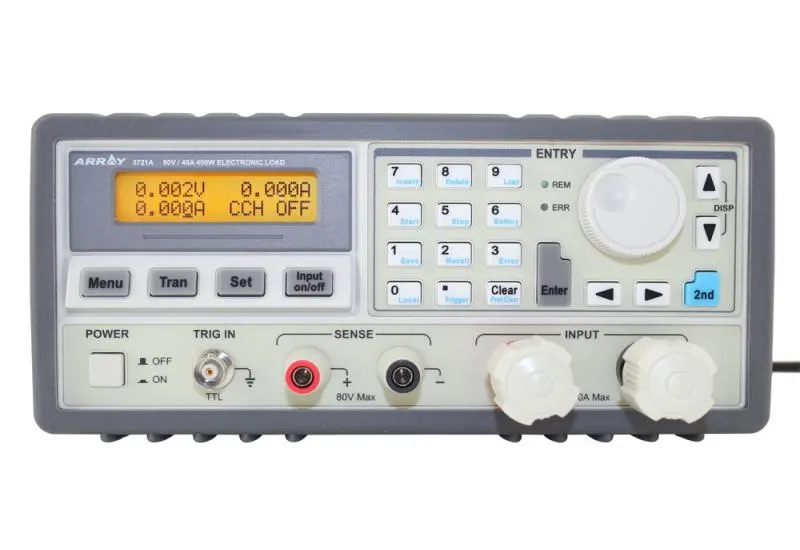
Electronic loads up to 400W
An electronic load tests power sources by emulating a device under test (DUT). Manufacturers and design engineers use them to test power supplies, DC-DC converters, chargers, adapters, batteries, solar panels, fuel cells and other power devices.
What to consider when choosing a load
Electronic loads are essential in battery and power supply testing, but choosing the right one for each application can be difficult because of the variety of options.
Type of power consumption
There are two main types: linear regulator and regenerative. Linear regulators are used in applications that require fast response and low noise. Regenerative loads use power switching devices to return the energy to the AC line.
Functions
Loads offer functions such as low-voltage operation, combined operating modes, remote control interfaces, time-dependent settings and measurement functions. It is worth defining which functions will be useful for your application.
Operating range
The range is given in terms of power, current and voltage. If your application requires more capacity than a load offers, it is not worth considering. If the load has much more capacity than the application, it is a waste of resources. Besides unnecessary cost and size, greater capacity can mean worse performance: often, the higher the rating, the worse the setting accuracy, setting resolution and response in lower-range applications.