


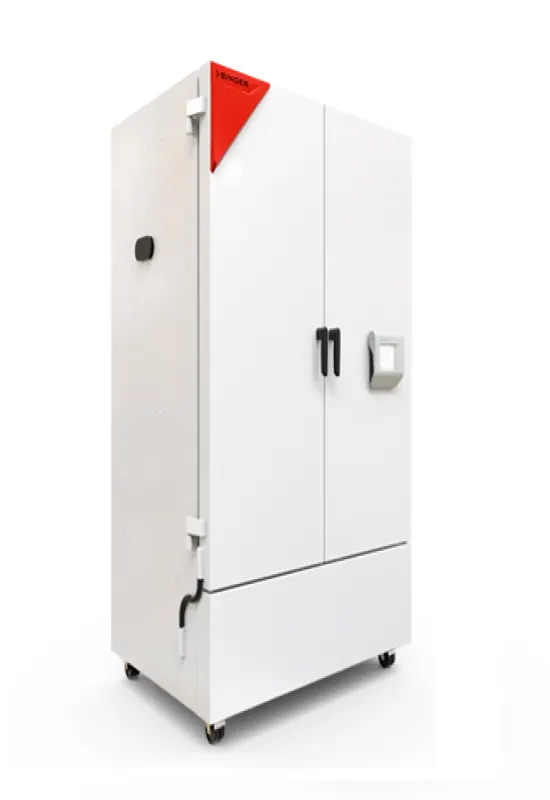
Climate chamber analysis for extreme environments
We simulate real conditions for critical results in aviation, automotive, electronics and more.
What a climate chamber is
It is a controlled environmental chamber that simulates temperatures (-70°C to +180°C), humidity (10% to 95% RH), altitude and more, to test how products behave in:
- Aviation: resistance to changes in pressure, vibration and humidity (DO-160, RTCA).
- Automotive: thermal cycling, exposure to dust and liquids.
- Electronics: component reliability (IEC 60068).
- Pharmaceutical: drug stability (ICH Q1A).
- Research: climate, materials and biology studies.
Key features
- Precise control: ±0.5°C, ±0.1% RH. 24/7 monitoring.
- Integrated cameras: IR thermography (FLIR), to detect hot spots and leaks; and a visual HD camera, for real-time recording and deformation analysis.
- Advanced simulation: altitude (up to 100,000 ft), vibration, rain and UV radiation.
- Cyclic tests: hot-cold and humidity-desiccation.
- Safety: alarms and remote access.
Applications
- Aviation: validation of components (engines, sensors, avionics) and high-altitude flight simulations.
- Automotive: batteries, sensors and electronics at extremes (-40°C to +85°C).
- Electronics: PCB reliability and thermal stress.
- Renewable energy: solar panels and wind turbines (humidity, ice cycles).
Advantages
- Reduces premature failures.
- Optimizes costs: detects weaknesses before launch.
- Supports regulatory compliance: RTCA, ASTM, ISO.
- Real-time data and predictive analysis.
Why choose us
- Experience in aviation (DO-160, AS9100).
- NISO/ASTM calibrated equipment.
- 24/7 technical support.
- Custom projects.
- Service in English.
Test examples
- Altitude sensors for military drones (30,000 ft simulation, -55°C).
- Li-ion batteries for electric cars (thermal cycle -20°C/+60°C).
If you need to test your product at extremes, contact us.
Metrological temperature verification
In environmental analyses and laboratory tests where temperature is a critical parameter, we verify our thermal systems in-house. Each test is backed by temperature validation in our dry-well calibrator, with an operating range of -30 °C to 150 °C, resolution of 0.01 °C, thermal stability of ±0.02 °C and indication accuracy of ±0.1 °C. Block uniformity (horizontal ≤ ±0.05 °C) and the controlled vertical gradient are also evaluated, to keep measurements within the established uncertainties.
In this way we confirm the stability, uniformity and accuracy of the test conditions. The expanded uncertainty of the system is determined according to the operating point, the sensor under test and the process conditions.