


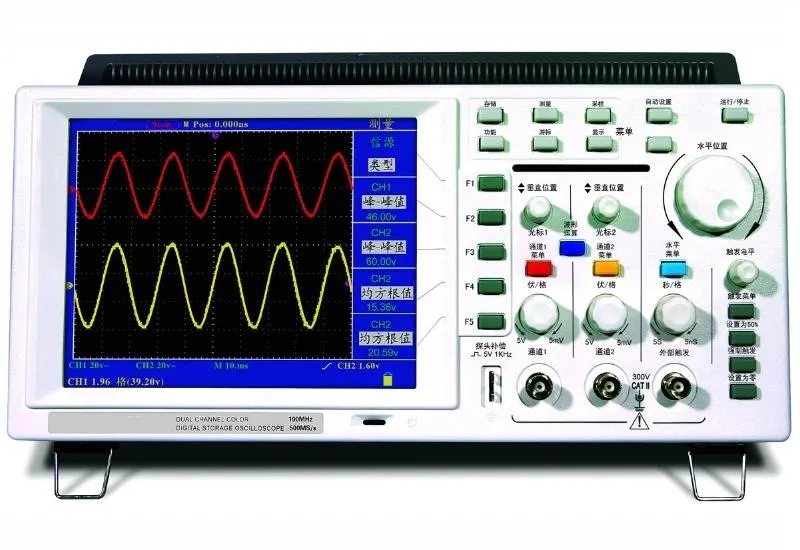
Video
We use cursors and delayed sweep to measure the rising and falling edges of a square wave.
Voltage measurement
The oscilloscope measures voltage directly. Other quantities, such as current or power, are obtained by calculation from it. Calculations for AC signals can be complicated, but the first step is always to measure the voltage.
The term voltage usually refers to the electric potential difference, in volts, between two points of a circuit. Normally one of the points is at ground (0 volts), and it is simplified by speaking of the voltage at point A, which is actually the potential difference between A and GND. Peak-to-peak voltages, between the maximum and minimum values of the signal, can also be measured. When measuring, always specify what type of voltage you are measuring.
Digital versus analog oscilloscopes
| Digital oscilloscope | Analog oscilloscope |
|---|---|
| Clean, bright trace, without intensity modulation | Allows intensity modulation. Brightness is low at high frequency. |
| Unlimited storage | Limited storage time and complex photographic techniques. |
| Increased resolution using cursors | Lower resolution, although they can have cursors. |
| Information from before the trigger using pretrigger | Pretrigger not available. |
| Variable bandwidth in real-time sampling. Wide bandwidth in equivalent-time sampling (up to 15 GHz). | Constant bandwidth dependent on amplitude (rarely above 1 GHz). |
| Slow screen update rate | Continuous acquisition |
| Higher cost than analog oscilloscopes | Moderate prices |
| Easy handling and analysis of single-shot signals | Cannot capture single-cycle signals |
| Easy documentation through connection to plotters, printers and computers | — |