


Video
https://www.youtube.com/watch?v=gvWdIlaBkJ0
What frequency is
Frequency is a quantity that measures the number of repetitions per unit of time of any periodic phenomenon or event.
To calculate it, count the occurrences of the event in a time interval and divide by the elapsed time. In the International System (SI), frequency is measured in hertz (Hz), in honor of Heinrich Rudolf Hertz. One hertz is an event repeated once per second; a two-hertz phenomenon repeats twice per second. This unit was originally called the cycle per second (cps).
Other units are revolutions per minute (rpm). Heart rate and musical tempo are measured in beats per minute (bpm).
Wave frequency
Frequency is inversely related to wavelength: the higher the frequency, the shorter the wavelength, and vice versa. The frequency f is equal to the wave velocity v divided by the wavelength λ (lambda).
Measuring the phase shift between two signals of the same frequency
We start from two sinusoidal signals of the same frequency. The phase shift is the phase difference between the two waves.
The phase shift between two signals of the same frequency can be measured in two ways:
- From the dual display of both signals. The two functions go to zero at instants t1 and t2, respectively.
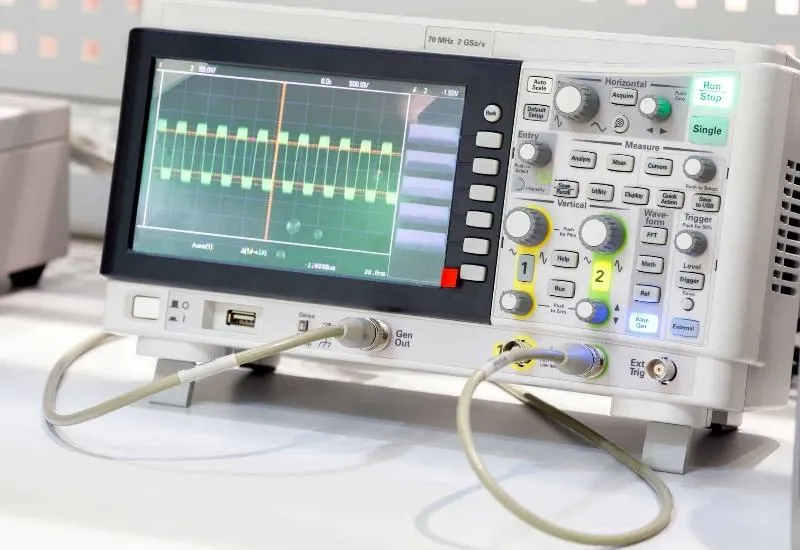
- Using Lissajous figures. They can be observed on the oscilloscope screen in x-y mode (by pressing key 5): the channel I signal is shown on the vertical axis and the channel II signal on the horizontal axis.