


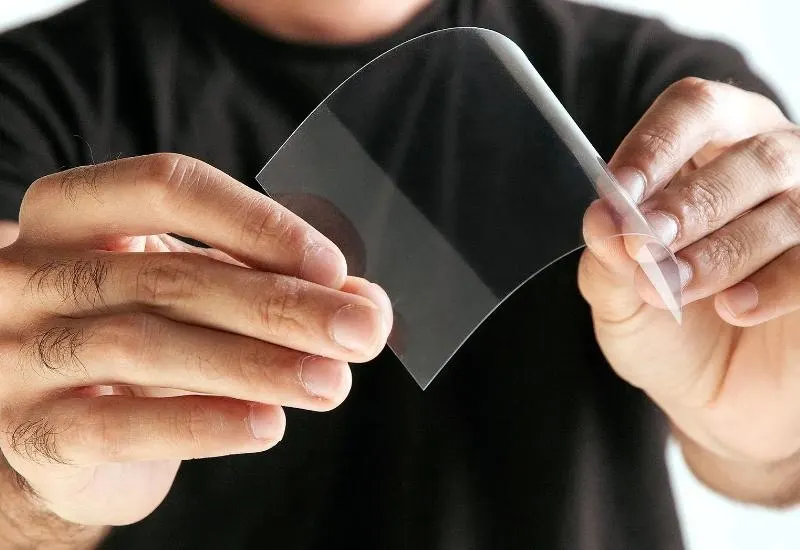
Graphene could revolutionize electronics
Konstantine Novoselov holds a degree in Physics from the University of Moscow (1997). At 35, he has received several of the most prestigious awards in science for his work with graphene.
Interview
Could you explain what graphene is?
It is simple: it is a layer of carbon so thin that it is only one atom wide. It has a hexagonal structure similar to a honeycomb. When many layers are stacked on top of one another you get graphite, a very common material.
Why is graphene so relevant?
Graphene sheets can be rolled up to form nanotubes, or modified to create structures similar to fullerenes. They can also be cut into nanoscale ribbons without changing their properties, and that makes them more versatile than other semiconductor materials for miniaturization. It is a very good electrical and thermal conductor.
How did you come up with the idea of working with graphite?
There had long been talk of electronics based on metals instead of semiconductors, but nobody had tried it with graphite, so we set about doing it. First we tried ground graphite powder, but it did not work. A very experienced person showed us how graphite samples were prepared for viewing under the scanning tunneling microscope: they cleaned the surface with adhesive tape. We tried it and were lucky enough to get a sample that was useful for our experiments.
With all the technology available, you prepare samples with adhesive tape?
Yes. It is a simple, cheap and effective method that works perfectly in the laboratory. Large-scale graphene production is another matter: that will require developing less artisanal techniques. Adhesive tape is within everyone’s reach, and so is graphite, and that may have helped the study of its properties spread so quickly.
Can it replace silicon in electronic applications?
Given its physical characteristics, yes. Silicon oxidizes and becomes unstable at scales ten times larger than those we can work at with graphene. That is a great advantage for making smaller circuits, even at the nanometer level, and graphene also works at room temperature rather than at low temperatures, as other devices do. Personally, I do not think it will replace silicon, because there is a huge industry behind it. It will coexist with silicon and improve the performance of transistors, which will be more efficient and work at much higher frequencies. That will translate into computers or mobile phones that transmit information faster.
Where will your research go next?
Graphene has only been around for a few years, so there is still a lot to find out, both about its applications and about the physics behind its performance. Part of my work is to continue in this field, but I am restless and I like new challenges. I want to think that I still have a long research career ahead of me and that I did not reach my limit when, a few years ago, we discovered graphene and managed to work with it.