


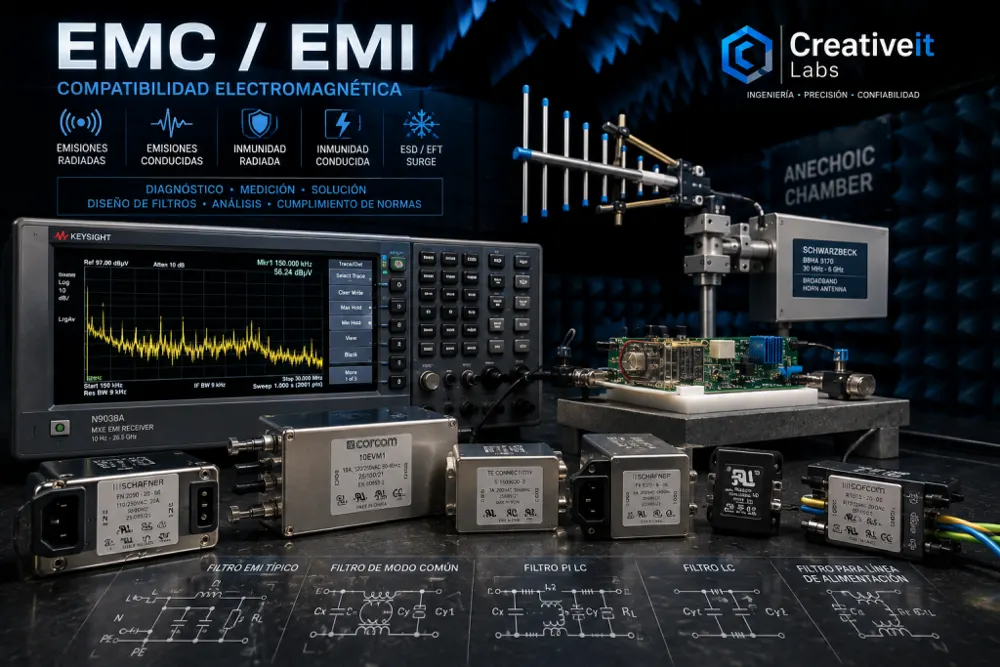
Evaluation and characterization for electronic equipment performance
Electromagnetic compatibility (EMC) is the ability of equipment or a system to operate correctly in an electromagnetic environment without generating interference that affects other devices and without being affected by it.
With more power electronics, wireless communications and industrial control systems, EMC testing is a fundamental requirement in the development, validation and certification of electronic products.
At Creativeit Labs we evaluate and characterize the electromagnetic behavior of products from manufacturers, research centers and engineering companies.
Services
Conducted emissions
We evaluate the electrical noise that equipment introduces into power and signal lines in order to identify sources of interference that affect other devices on the same network.
Radiated emissions
We determine the electromagnetic energy that equipment emits to verify that it stays within the limits of international standards and does not interfere with other systems.
Conducted immunity
We analyze whether the equipment continues to operate correctly when electrical disturbances enter through power or communication lines.
Radiated immunity
We evaluate the performance of equipment exposed to electromagnetic fields from transmitters, wireless systems and other electronic equipment in its environment.
Electrostatic discharge (ESD)
We verify the ability of equipment to withstand electrostatic discharges produced by people, tools or materials during operation and handling.
Electrical transients (EFT/Burst)
We simulate fast disturbances from switching operations, motors and inductive loads to evaluate the equipment’s immunity.
Overvoltages (Surge)
We evaluate whether the product withstands overvoltages from indirect lightning strikes or switching events on the power grid.
Electromagnetic interference (EMI) analysis
We identify the sources of electromagnetic noise that cause operating, communication or performance problems.
EMC diagnostics and troubleshooting
We carry out technical studies to locate the source of interference and propose solutions through design improvements, shielding, filters, grounding and component layout.
Equipment we evaluate
- Industrial electronic equipment.
- Medical equipment.
- Automotive systems.
- IoT devices.
- Telecommunications equipment.
- Power electronics.
- Inverters and converters.
- Power supplies.
- Embedded systems.
- RF and microwave equipment.
- Electronic boards (PCB).
- Sensors and electronic modules.
Sectors we serve
Electronics and automotive industries, telecommunications, aerospace, energy, medical devices, research centers, universities, electronic equipment manufacturers, and engineering and technology development companies.
Benefits of EMC testing
- Early identification of interference problems.
- Fewer failures during product development.
- Optimization of electronic design.
- Less redesign time and cost.
- Greater reliability of the final product.
- Better performance in industrial environments.
- Preparation for international certification processes.
Reference standards
Tests can be carried out taking into account the methodologies and requirements of widely recognized standards, including:
- IEC 61000
- CISPR
- FCC
- MIL-STD
- ISO 11452 (Automotive)
- ISO 7637
- IEC 60601 (Medical equipment)
- DO-160 (Aeronautics)
Why Creativeit Labs
- Specialized instrumentation for EMC and EMI analysis.
- Engineering focused on diagnosing and solving electromagnetic problems.
- Staff with experience in electronics, RF and electromagnetic compatibility.
- Custom tests according to project needs.
- Detailed technical reports with interpretation of results.
- Support during the development and optimization of electronic design.
Applications
New product development, prototype validation, research and development (R&D), electronic failure diagnostics, PCB optimization, electronic system integration, automotive and industrial electronics, wireless communication systems and high-reliability equipment.
Request a quote
We help manufacturers and integrators identify and correct interference problems before manufacturing or certification, to reduce development costs and improve equipment performance under real operating conditions.