


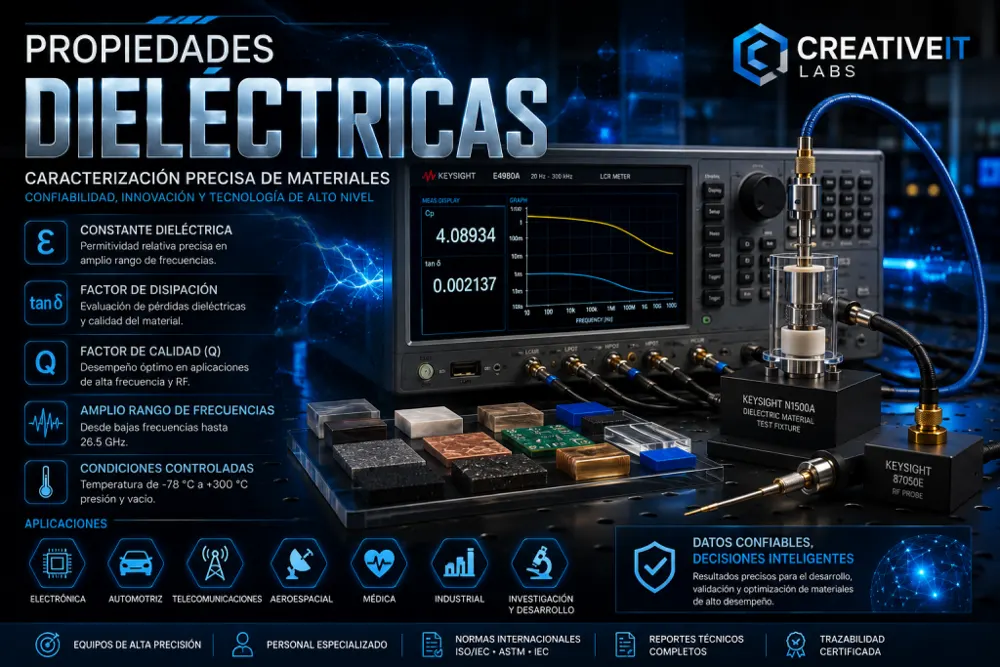
Electrical characterization of materials
The dielectric properties of a material determine how it responds to an electric field and how it stores, transmits and dissipates electromagnetic energy. Knowing them is necessary to select materials, develop products, validate suppliers and evaluate components for electronics, RF, microwave, automotive and other high-technology applications.
At Creativeit Labs we perform electrical and dielectric characterization of solid and liquid materials and components. We determine their main electrical parameters and evaluate their behavior as a function of frequency.
The tests apply to polymers, resins, ceramics, composite materials, laminates, PCBs, insulating materials, encapsulants, elastomers and other materials used in electronic and high-frequency applications.
Dielectric characterization parameters
Depending on the material, the sample geometry, the measurement method and the required frequency range, we can determine various electrical and dielectric parameters.
Permittivity and dielectric constant
We determine electrical permittivity and relative dielectric constant (εr). They indicate the material’s ability to store electrical energy and are key to the design of:
- Electronic circuits
- Capacitors
- Antennas
- Sensors
- High-frequency PCBs
- RF components
- Microwave components
- Encapsulation materials
Where appropriate, the characterization considers complex permittivity, with its real and imaginary components.
Dielectric losses and loss tangent
We evaluate losses from energy dissipation within the material by means of:
- Dissipation factor
- Loss tangent (tan δ)
- Dielectric losses
- Imaginary permittivity (ε″)
These parameters matter wherever electrical losses must be kept under control. The dissipation factor also helps identify aging, contamination, moisture and insulation degradation.
Capacitance and impedance
Depending on the test setup, the following can also be determined:
- Capacitance
- Impedance
- Reactance
- Admittance
- Conductance
- Susceptance
- Phase angle
- Quality factor (Q)
These measurements make it possible to analyze the electrical behavior of materials and components under different frequency conditions. The quality factor (Q) describes the material’s performance at radio and microwave frequencies, where losses must be minimal.
Characterization as a function of frequency
The electrical properties of a material do not necessarily remain constant as the frequency changes. That is why frequency characterization shows how permittivity, dielectric losses, impedance and quality factor evolve. We evaluate the response from low frequencies up to radio frequency.
We have instrumentation for electrical and RF measurements, with characterization capability up to 26.5 GHz, depending on the method, the fixture, the sample and the test setup.
Characterization methods
The technique depends on the type of material, its dimensions, its electrical properties and the frequency range. The techniques and setups we use include:
- Methods based on impedance measurement.
- Measurements of capacitance and electrical parameters.
- Characterization with network analyzers.
- Measurements with specialized accessories and fixtures.
- Coaxial methods for RF applications.
- S-parameter measurements when the application and test setup require them.
Sample preparation and fixture selection are decisive in obtaining representative results.
Materials we characterize
Characterization applies to various families of electrical and electronic materials. The methodology is selected for each sample.
- Engineering plastics
- Polymers
- Epoxy resins
- Silicones
- Ceramics
- Composite materials
- Laminates, including FR-4 (FR4)
- PCBs
- Insulating materials
- Elastomers
- Dielectric oils
- Encapsulation materials
- Materials for power electronics
- Materials for RF, microwave and high-frequency applications
- Materials for automotive applications
- Electronic components
- Other nonmetallic materials used in electronic systems
Characterization for RF and microwave
At high frequencies, knowing the dielectric properties is essential to predict electromagnetic behavior. Permittivity and dielectric losses directly influence the impedance, propagation velocity, transmission losses, efficiency and behavior of RF circuits and structures.
Characterization is useful during the development and validation of:
- Antennas
- High-frequency PCBs
- RF materials
- Microwave components
- Sensors
- Electronic packages
- Composite materials
- Electronic devices
- Automotive systems
- Telecommunications
The frequency range and measurement technique are defined according to the material and the test objective.
Industrial applications
The results are used to:
Research and development
Compare and select materials during the development of new products and technologies (R&D).
Quality control
Verify the electrical properties of incoming materials or materials used in manufacturing processes.
Material comparison
Comparatively evaluate formulations, suppliers or candidate materials.
Failure analysis
Investigate changes in electrical properties associated with degradation, contamination, moisture, aging or other failure mechanisms.
Supplier validation
Compare the electrical properties of materials from different suppliers or manufacturing lots.
Product engineering
Obtain the electrical parameters needed for simulation, design and material selection.
The tests are also used in the development of new materials, optimization of manufacturing processes, product certification and reverse engineering.
Characterization under different conditions
When the project requires it, measurements can be planned with specific environmental or aging conditions:
- Temperature
- Humidity
- Exposure time
- Aging, including accelerated aging
- Conditions before and after environmental exposure
The objective is to determine whether the electrical properties change significantly after the material is subjected to certain operating or aging conditions. The availability and scope of each condition depend on the test setup.
Results and technical report
We document the results in a technical report with the measured parameters, the test conditions, the sample identification and the results obtained. Depending on the test, they are presented as:
- Electrical and dielectric values.
- Measurement tables.
- Parameters as a function of frequency.
- Behavior plots.
- Comparison between different samples.
- Information on the conditions used during measurement.
This information supports product development, quality control, material selection and engineering analysis.
Why characterize dielectric properties
Knowing the electrical behavior of a material lets you make decisions before incorporating it into a product or process. Characterization helps to:
- Select suitable materials for an application.
- Compare materials from different suppliers.
- Determine dielectric losses.
- Evaluate electrical behavior as a function of frequency.
- Obtain parameters for design and simulation.
- Investigate changes caused by aging.
- Identify variations between samples or lots.
- Improve the reliability of electronic products.
- Determine the quality of electrical insulation.
- Reduce the risk of electrical failures.
Why Creativeit Labs
We perform electrical and materials characterization with precision measuring instrumentation and various test setups, according to each project. Before measuring, we review the sample, the frequency range, the required parameters and the objective in order to define the most suitable methodology.
- High-precision measuring equipment.
- Staff specialized in the electrical characterization of materials.
- Experience with electronic and high-technology materials.
- Custom tests according to customer needs.
- Technical reports with analysis and interpretation of results.
- Service to the industrial, automotive, electronics, energy, aerospace and research sectors.
The materials are used in electronic equipment, power systems, telecommunications, medical devices and aerospace applications. Talk to the engineer: tell us about your sample and your application, and we will propose the methodology and a quote.