


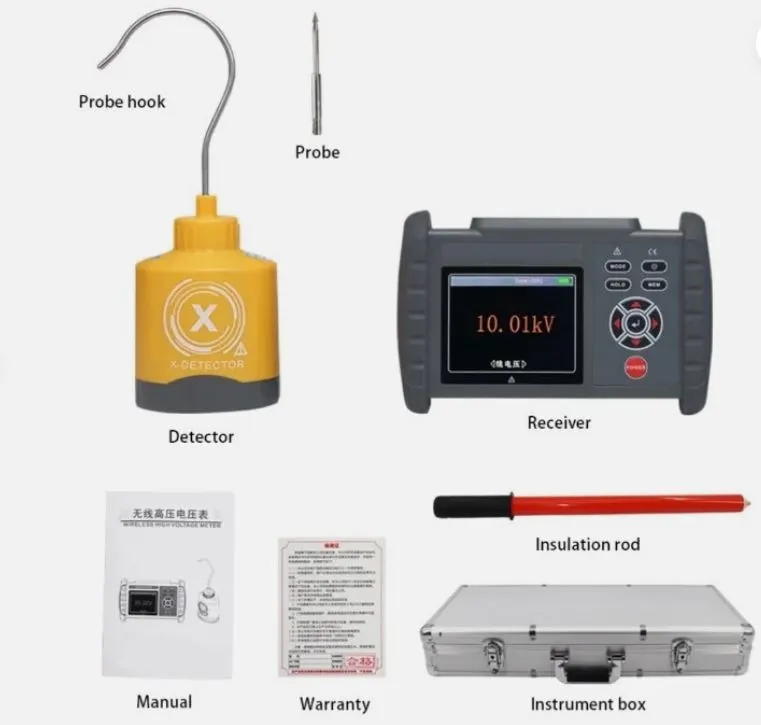
The wireless digital high-voltage meter measures voltage in medium- and high-voltage electrical systems. A wireless sensor is placed on the conductor with an insulated hot stick and transmits readings in real time to a portable receiver unit. The operator measures from a safe distance, with no direct connections to the circuit.
It is used to verify the presence of voltage, check phase-to-phase and phase-to-ground voltage levels, inspect overhead distribution and transmission lines, electrical substations and industrial load centers, and support preventive and corrective maintenance and commissioning. Because it is wireless, it reduces personnel exposure to energized areas.
Its benefits: digital readout, wireless data transmission, simple operation, immediate response and compatibility with insulated hot sticks for medium- and high-voltage installations. Its design is rugged and portable.
Applications
- Voltage measurement on medium- and high-voltage lines.
- Verification of voltage presence and level.
- Inspection of overhead distribution and transmission lines.
- Preventive and corrective maintenance of electrical systems.
- Commissioning of electrical installations.
- Inspection of electrical substations.
- Diagnostics of industrial and commercial distribution networks.
- Safe voltage verification on energized conductors.
Voltage range
It allows testing on systems from 0.1 kV to 220 kV, on low-, medium- and high-voltage networks, including 110 V, 220 V, 3 kV, 6.3 kV, 10 kV, 35 kV, 66 kV, 110 kV and 220 kV systems. This range avoids the need for a different detector for each voltage level, which reduces costs and optimizes maintenance.
Induced voltages
During line repair and maintenance, induced voltages may remain even after a line is de-energized, due to the capacitive effect of nearby energized conductors. They pose a significant risk to personnel. The meter makes it possible to verify that the residual voltage has dropped to a safe level before work begins.
System components
The system consists of a portable receiver, a wireless detector sensor and a telescopic insulated hot stick. To measure, the detector is placed on the bare conductor with the hot stick and transmits readings wirelessly to the receiver, with an approximate range of 30 meters in line of sight.
The detector includes LED indicator lights and audible alarms, which confirm the presence of voltage visually and audibly.