


Why measure at elevated voltages
In the automotive industry, electrical reliability is essential. Connectors, electronic modules, sensors, harnesses, coatings and polymers must maintain high insulation resistance values under heat, humidity, vibration and electrostatic buildup. Under these conditions, insulation resistance and resistivity do not remain constant: they change with the applied voltage.
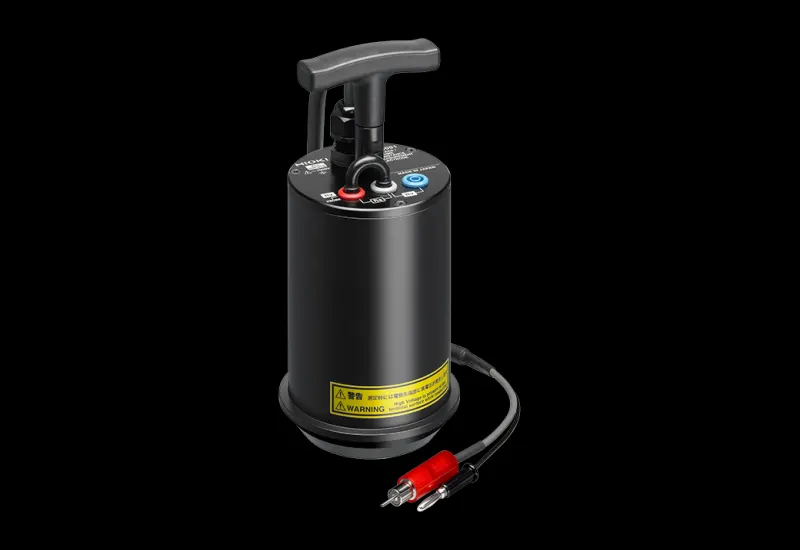
Most high-resistance meters on the market apply only 1 to 5 volts and give optimistic values that do not represent real conditions. The Hioki SM-8213 applies adjustable voltages up to 100 V, which allows a reproducible analysis of the dielectric behavior of automotive components under more realistic electric fields.
Measuring at 20, 50 or 100 V
Electrical resistivity depends on the applied electric field. When materials or parts are evaluated at only 1–5 V:
- Micro-leakage and material faults stay hidden.
- Polymers appear more insulating than they are.
- Humidity and surface contamination go undetected.
- Failures from aging, UV or thermal stress do not appear.
Applying 50–100 V reproduces a condition closer to real operation and reveals:
- Leakage from humidity or contamination, invisible at 5 V.
- Polymer degradation from heat or aging.
- Incipient dielectric breakdown and encapsulation failures.
- Non-linear behavior in ESD dissipative materials.
Automotive applications that require 100 V
1. Automotive connectors
OEMs require insulation resistance to be evaluated at typical voltages of 50–100 VDC to detect leakage between pins and contamination failures in:
- Terminals
- Plastic housings
- Sealed connectors
- Fuse blocks
At 5 V a contaminated connector can pass the test; at 100 V the real leakage is detected.
2. Sensors and electronic modules
Temperature, pressure and ABS sensors, ECUs and harnesses can have micro-leakage that shows up only under high electric fields. At elevated voltages, microdefects appear in PCBs, encapsulants, resins and terminals. The SM-8213 makes it possible to detect:
- Trapped moisture
- Delamination
- Encapsulation failures
- Solder contamination
3. Plastics, elastomers and coatings
Dashboards, interiors, seals and plastic components suffer thermal degradation, UV exposure and heat stress, which reduce their real resistivity. Testing at 50–100 V simulates the environment inside the vehicle.
4. Dissipative and antistatic (ESD) materials
Many ESD materials change their resistivity with voltage, so measuring at a single low voltage gives an incomplete reading. With 100 V you obtain:
- A non-linear behavior curve
- Verification of stability under field
- Safety analysis for sensitive electronic components
Advantages of the Hioki SM-8213
- Programmable measurement voltage from 1 V to 100 V.
- Detection of leakage that goes unnoticed at 5 V.
- Suitable for Tier 1 and Tier 2 automotive laboratories.
- Compatible with volume and surface measurement accessories, including SME-8310 electrodes.