


Electrical resistance analysis of liquids by direct current (DC)
We analyze liquids by direct current and also by high-frequency alternating current.
The direct current (DC) electrical resistance test makes it possible to assess the ability of a fluid to oppose the flow of electric current. It identifies the fluid’s purity, its contamination level and its behavior as an insulating material.
This analysis is fundamental to characterizing dielectric oils, lubricants, cooling fluids and insulating liquids used in high-voltage electrical and electronic equipment.
Test objective
The measurement determines the volume resistivity or surface resistance of the liquid under a constant electric field. The results indicate whether the fluid offers adequate electrical protection or contains conductive impurities, such as moisture, ions or particles, that affect its dielectric performance.
Measurement principle
A DC voltage is applied between two electrodes immersed in the sample. The instrument measures the leakage current flowing through the liquid and, from it, calculates the resistance and resistivity. This method, in accordance with ASTM D1169, is the most widely used for determining the specific resistivity of oils and insulating fluids.
Types of resistance in liquids
- Volume resistance: measures the opposition to the flow of current through the volume of the liquid. It is the most representative for determining ionic purity.
- Surface resistance: assesses the current over the surface of the liquid or in thin films. It is useful when studying coatings, conductive films or surface contamination.
Main applications
- Evaluation of dielectric oils in transformers and capacitors.
- Monitoring of new or in-service insulating fluid to determine its degree of aging.
- Material compatibility tests to detect the release of conductive contaminants.
- Research in the development of new insulating liquids and electrical coolants.
- Analysis of ionic contamination or moisture absorption in industrial liquids.
Advantages of the DC method
- High sensitivity for detecting small leakage currents.
- Ideal for liquids with very high resistivity.
- Results comparable with international standards (ASTM, IEC).
- Direct assessment of the dielectric quality of the fluid.
Equipment used
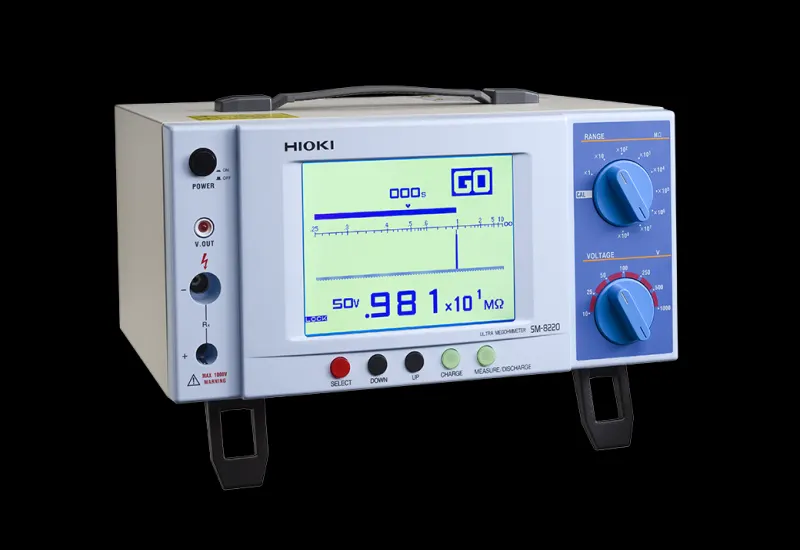
We work with specialized instruments such as the Hioki SM-8213 Super Megohmmeter. It applies a controlled DC voltage of 5 to 100 V and measures resistances in the range of 10⁴ to 10¹⁴ Ω.