


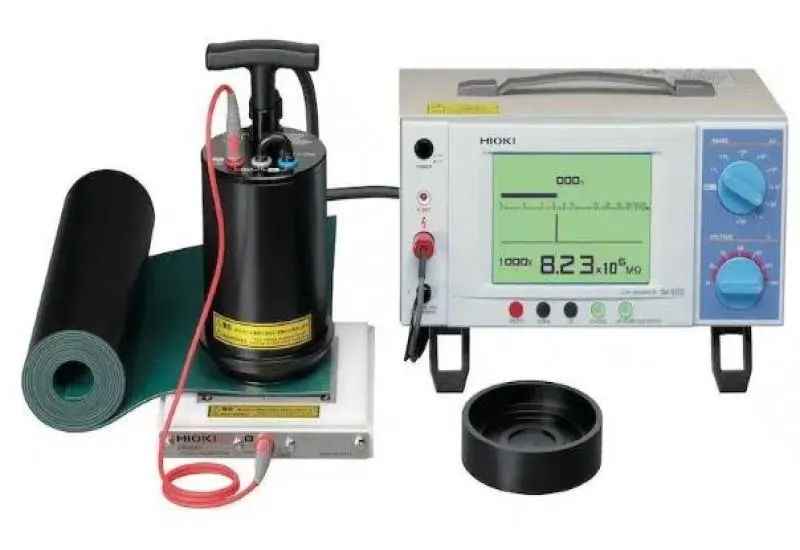
Materials testing to current standards, with evidence
At our laboratory we measure surface resistance to determine the ability of materials to dissipate or retain electrical charge on their surface, in accordance with ASTM D257 / IEC 61340, ANSI/ESD STM11.11.
The test is fundamental to the quality control of ESD, dissipative, conductive and insulating materials used in the electronics, automotive, aerospace and packaging industries.
What the test involves
A potential difference is applied across the surface of the material with a concentric ring electrode or a standardized contact probe array. The instrument measures resistance in ohms per square (Ω/m), which allows the material to be classified by its electrical behavior:
- Conductive: below 10⁵ Ω/m
- Dissipative: between 10⁵ and 10¹¹ Ω/m
- Insulating: above 10¹¹ Ω/m
This parameter indicates whether a material can dissipate static charges safely or whether it requires additional treatment.
Materials that can be analyzed
- Conductive and dissipative plastics.
- ESD coatings and antistatic paints.
- Films, packaging and protective bags.
- Mats, textiles or uniforms with antistatic treatment.
- Electronic components and plastic housings.
- Metal surfaces with special coatings.
Applicable standards
- ASTM D257 – Standard methods for measuring resistance or conductance of insulating materials.
- IEC 61340-2-3 – Test methods for determining the resistivity of ESD protective materials.
- ANSI/ESD STM11.11 – Surface resistance measurement of planar dissipative materials.
Industrial applications
The analysis is essential wherever electrostatic charge control is critical:
- Electronics and microelectronics.
- Automotive.
- Aerospace.
- Medical and hospital.
- Manufacture of ESD packaging, floors and coatings.
The information obtained makes it possible to select materials for controlled zones, assembly lines, packaging of sensitive components and areas at risk of electrostatic discharge.
Results
The results include the ESD classification of the material, the environmental conditions of the test (temperature and relative humidity) and, when required, the complete measurement curve. Measurements are made with calibrated and certified equipment.