


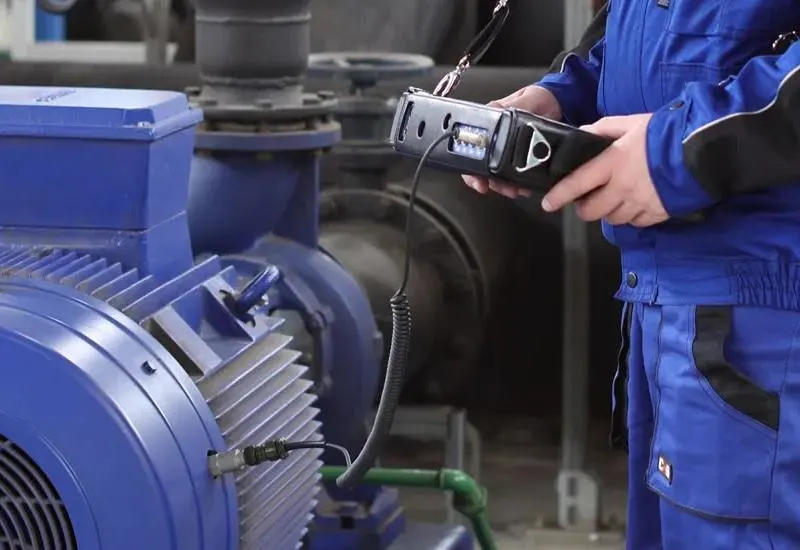
Vibration in motors and rotating equipment
We rent equipment and perform vibration analysis and testing, with equipment in immediate stock. The service is professional, with 100% automatic equipment. We use only triaxial accelerometers, for speed and effectiveness. You will have the equipment the same day you contact us.
We provide vibration service for all rotating equipment, compressors, piping and ducts in Monterrey. We also rent Fluke automatic analyzers. We carry out all work in accordance with current standards. We are members of the IEEE and the DEIS, and we have the latest printed standards.
Our Fluke 810 video on YouTube: https://www.youtube.com/watch?v=wuYcQm9plDs
Equipment types: motors, turbines, shafts, fans, pumps, centrifuges, etc. On the electrical side we use only Fluke class A equipment, and on the thermographic side, Flir with MSX. You can also rent the equipment to direct the work yourself and produce your own reports at a much lower cost. We have Megger equipment for insulation analysis and grounding resistance, and a micro-ohmmeter for low resistances. We test substation transformers.
On the electrical side
Typical motor checks include insulation measurements on coils, cables and windings. We also look for turn-to-turn short circuits in the stator windings, caused by excessive vibration and by heating under operating overloads.
We review all facets of electrical quality: problems with the quality of the supply feeding the motor, imbalance between phase voltages, high starting currents and specific parameters such as harmonics, unbalance, transients, fluctuations, inrush currents and flicker.
On the mechanical side
We mainly use the Fluke 810 with a triaxial accelerometer, which allows readings at fewer points on the motor and gives the axial, tangential and radial displacements at a single point. Asynchronous motors account for more than 90% of industrial drives, because of their construction advantages and operating simplicity. They show characteristic failure modes that can be detected and analyzed with technologies developed for electric motor analysis.
The most characteristic electromechanical problems that can be detected and confirmed with this technology are:
- Broken bars, with an estimate of the whole number or percentage of discontinuity.
- Static iron eccentricity, due to permanent deformation, uneven foot seating or excessive bearing wear that moves the rotor off its magnetic center.
- Bearing defects or lubrication problems.
- Mechanical problems such as misalignment, looseness or unbalance.
We also rent the equipment so that you can take the measurements at a lower cost. For more information, click here.
On the thermal side
We use high-resolution Flir MSX (multi-spectral dynamic imaging) thermographic cameras. Possible problems include heating of the iron by eddy currents, due to short circuits in the magnetic laminations. Ideally, motors should be checked while running under normal operating conditions.
Unlike infrared thermometers, which capture the temperature of a single point, a thermographic camera simultaneously captures the temperature of thousands of points on the main components: the motor, the shaft coupling, the motor bearings, the shaft itself and the gearbox. This shows whether any area is running hotter than others.
We also rent thermographic cameras so that customers can take the images themselves. For more information, click here.