


Insulation analysis course with DC3 certificate in Monterrey
Our instructors are qualified and certified in adult education, with an andragogical methodology. We teach courses on insulation analysis and can train your staff before the STPS: we hold registrations that allow us to issue the DC-3 labor skills certificate, a Mexican labor certificate.
At the end of each training session we also issue certificates valid before the State or Municipal Civil Protection authorities (Nuevo León). All courses are taught by instructors certified in andragogical methodology focused on adult education. The subject matter is tailored to the students present on each occasion: every course is different, and the time spent on a parameter or topic depends on the students and their current needs.
What is included
- Certification manual, support documents and workbook.
- Participant assessment and course evaluation.
- DC3 certificate and/or skills certificate on insulation analysis, issued on passing the exam.
What electrical insulation is
Every electrical wire in your plant, whether in a motor, generator, cable, switch, transformer or elsewhere, is covered with some form of electrical insulation. The wire, usually copper or aluminum, is a good conductor of the current that powers your equipment. The insulation must be the opposite: it must resist the current and keep it on its path along the conductor. You do not need the mathematics of electricity to understand insulation testing; Ohm’s law, a single equation, helps you appreciate many aspects of it. The insulation of a conductor serves a purpose similar to that of a pipe carrying water, and Ohm’s law is easiest to understand by comparison with the flow of water.
The water pressure from a pump causes the flow along the pipe. If the pipe had a leak, water would be wasted and some pressure would be lost. In electricity, voltage is similar to the pump pressure and makes electricity flow through the copper wires. As in a water pipe, there is some resistance to the flow, but it is much lower along the wire than through the insulation.
Electrical insulation consists of covering an element of an electrical installation with a non-conductive material that prevents current from passing to the outside. It should not be confused with dielectric materials: all dielectrics can be insulators, but not all insulators are dielectrics. There are different classes of insulation, used to differentiate the protective grounding connection conditions of devices. Some materials, such as air or water, are insulators under certain conditions and not under others. Air, an insulator at room temperature and at relatively low signal and power frequencies, can become a conductor.
Insulation deterioration
Electrical insulation starts to deteriorate from the moment it is manufactured, and this reduces its performance. Harsh working environments, especially those with high temperatures or chemical contamination, accelerate the deterioration. As a result, power reliability and personnel safety are affected. For maintenance it is very important to identify this deterioration as early as possible and take corrective action.
Insulation resistance test
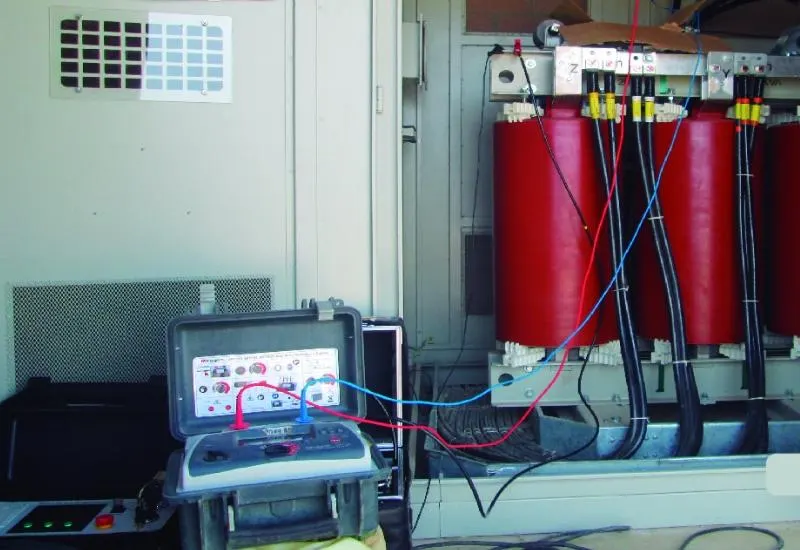
The test basically consists of applying voltage between the electrodes and measuring the current flowing through the circuit. The test equipment is made up of a direct current source and a meter for that current. The current depends not only on the insulation resistance but also on its capacitance. Strictly speaking, the insulation resistance test should be called an insulation impedance test, because there is also a capacitive effect.