


Grounding study course
We offer courses with a DC3 skills certificate. We explain clearly, use real examples and propose debates among the students to assess them. We reinforce learning with feedback from student to instructor and from instructor to student, to confirm that the knowledge has been acquired.
We have instructors qualified in grounding studies and can train your staff in-house. We hold registrations with the STPS that allow us to issue the DC-3 labor skills certificate, a Mexican labor certificate. The certificates are valid before the State and Municipal Civil Protection authorities (Nuevo León).
All courses are taught by instructors CERTIFIED in andragogical methodology, focused on adult education. The subject matter is tailored to the students present on each occasion: every course is different, and the time spent on each parameter or topic depends on the students and their current needs.
What is included
- Certification manual, support documents and workbook.
- Participant assessment and course evaluation.
- Skills certificate endorsed by the STPS.
We use the internationally known 4-pin Wenner ASTM G57 method to measure resistivity. The course adheres to the Mexican official standard NOM-022-STPS-2015, Electricidad estática en los centros de trabajo – Condiciones de seguridad.
Why a proper grounding connection matters
The grounding connection is a fundamental element of any electrical installation. Grounding is provided to limit the voltage that metal parts can present with respect to ground, to ensure that protective devices operate, and to eliminate or reduce the risk of a fault in electrical materials. In this way it protects both equipment and people from dangerous potential differences.
The course presents various instruments for measuring grounding, along with some grounding systems that serve to:
- Keep people safe, by limiting touch voltage.
- Protect installations, with a low-impedance path.
- Improve signal quality, by minimizing electromagnetic noise.
- Establish a reference potential, by making the system equipotential.
Design factors for a grounding connection
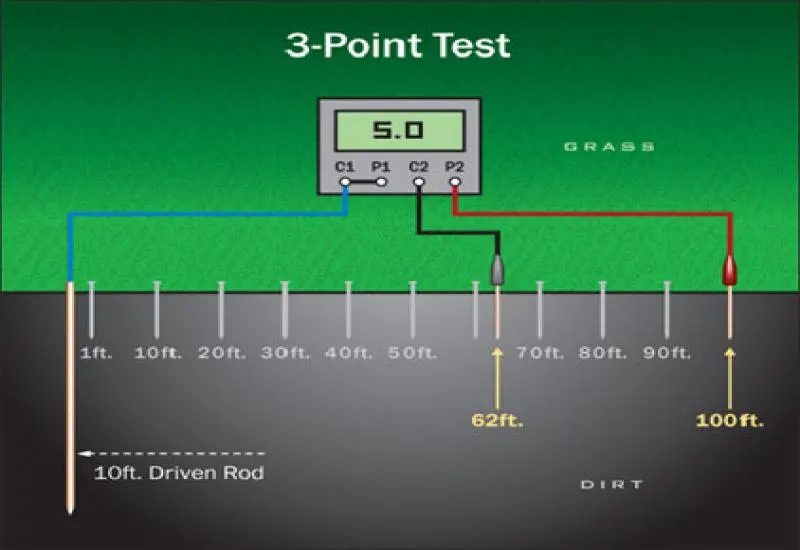
To obtain an effective grounding connection it is essential to achieve a low ground resistance, with conductors of a cross-section suited to the expected current and with high corrosion resistance. The electrical resistance of the grounding connection must be measured isolated from every conductive element. That is why disconnecting elements are needed to separate the grounding connection from the rest of the installation during measurement.
Other decisive factors when designing a grounding connection:
- To measure the resistance routinely, an inspection pit must be installed.
- Soil moisture reduces ground resistance.
- Ground enhancement compounds reduce soil resistivity.
- Buried electrical or gas installations must be known, in order to keep the safety distance specified in each case.
- Buried water pipes or tanks must be known, in order to bond the grounding connection equipotentially to them.
In high-resistivity soils, an adequate grounding resistance requires special electrodes for low-conductivity soils, deep electrodes or perimeter conductor rings.