


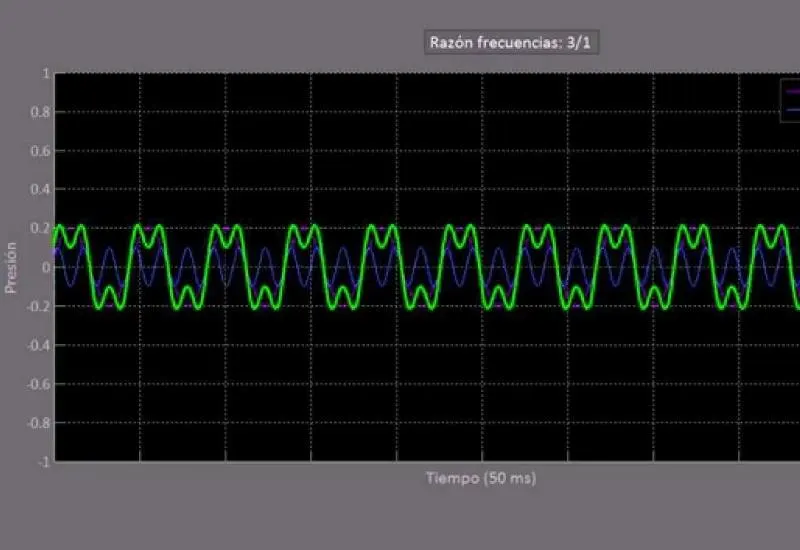
Two frequencies on an oscilloscope
In the video we see two very distant signals, one at 1 Mhz and the other at 30 Mhz, displayed on an oscilloscope at the same time.
Two separated loudspeakers
First problem
Suppose 2 loudspeakers 1 meter apart, driven by the same oscillator, emit a sound of frequency 1150 Hz. A person is 4.0 meters from one of the loudspeakers. How far must the person be from the second loudspeaker to notice destructive interference? Assume that the speed of sound in air is 343 m/s.
Second problem
A stationary source emits a 5000Hz sound wave. An object approaches the stationary source at 3.5m/s. What is the frequency of the wave reflected from the object?
Doppler effect
The Doppler effect is the change in frequency of a sound due to the motion of the source or the observer. If they approach each other, the frequency increases; if they move apart, it decreases. The new frequency f’ perceived by the observer is given by the formula:
f’ = (v ± vo) / (v ∓ vs) · f
The first symbol in the numerator goes with the first symbol in the denominator.
Where v is the speed of sound, v0 is the speed of the observer and vs is the speed of the source. The upper signs (+ and -) apply if the source and/or the observer are approaching, and the lower signs (- and +) if they are moving away.