


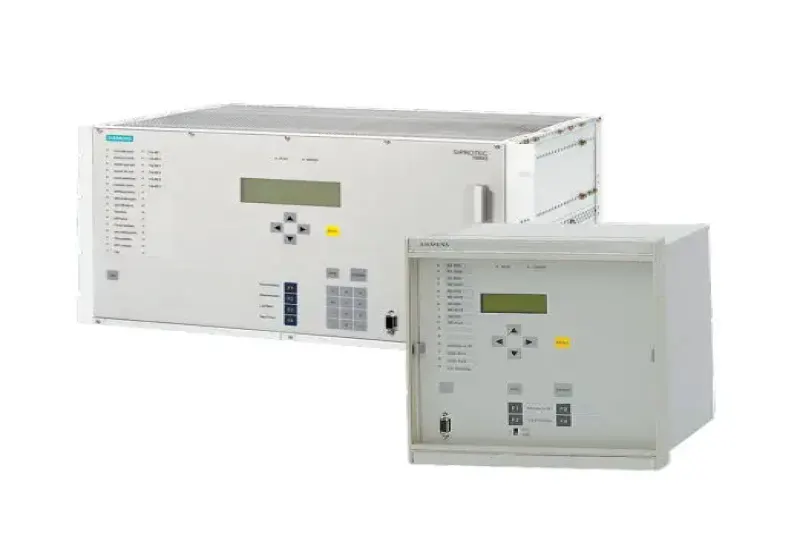
Testing, verification and commissioning of Siemens relays
We perform Siemens protection relay testing in Monterrey, Nuevo León, to verify the operation, configuration and response of protection systems in industrial electrical installations, substations, generation plants, distribution and other power systems. The tests confirm that protection functions respond to abnormal conditions and act selectively and in coordination to limit the effects of an electrical fault.
A properly configured and tested relay must detect fault conditions within the established parameters, issue the corresponding signals and operate the associated circuit breakers or devices within the required time. For this reason, verification is not limited to commissioning a new installation: it is also done after modifications, configuration changes, maintenance, firmware updates or adjustments to electrical systems.
We test various families of Siemens protection relays, including devices from the SIPROTEC 5, SIPROTEC 4 and Reyrolle 5 platforms, with procedures adapted to the functions and characteristics of each device.
Why test protection relays
Relays remain in supervision, waiting for an abnormal condition. When a fault occurs, they must recognize the magnitude and nature of the event and act according to the programmed protection logic. A defect in the configuration, wiring, trip logic or parameters can cause:
- Incorrect tripping of a circuit breaker.
- Failure to trip on a fault.
- Operation outside the required time.
- Loss of selectivity.
- Unnecessary disconnection of loads.
- Incorrect operation of protection schemes.
- Communication failures.
- Problems with input and output signals.
The tests verify that the relay responds according to the established parameters and that the configuration is consistent with the actual conditions of the installation.
Siemens SIPROTEC relay testing
SIPROTEC relays are widely used for the protection and automation of electrical installations. Depending on the model and application, they can integrate protection, measurement, control, automation and communication functions. We test devices from these families:
Siemens SIPROTEC 5
A modern protection, control and automation platform for electrical systems. Depending on the device, applications include:
- Line protection.
- Transformer protection.
- Motor protection.
- Generator protection.
- Busbar protection.
- Feeder protection.
- Distribution system protection.
- Substation control and automation.
The tests are defined according to the specific model and the enabled functions.
Siemens SIPROTEC 4
A family widely used in industrial installations and electric power systems. The evaluation can include the configured protection functions, inputs, outputs, trip signals and associated parameters.
Siemens Reyrolle 5
A family of protection platforms used in electrical systems. The tests are carried out according to the relay’s function, its configuration and the protection scheme in which it is installed.
Functional relay testing
Functional tests verify that the relay responds correctly to electrical signals representative of the conditions it must detect. Depending on the application, the following are evaluated:
- Current.
- Voltage.
- Frequency.
- Phase angle.
- Phase sequence.
- Binary inputs.
- Binary outputs.
- Trip signals.
- Alarm signals.
- Protection logic.
- Time delays.
The objective is to confirm that the programmed functions respond according to the established values and times.
Overcurrent protection testing
One of the most common functions is overcurrent protection. The tests verify the relay’s response to different current levels and whether it operates according to the configured parameters. Depending on the relay, the following are evaluated:
- Instantaneous overcurrent.
- Time-delayed overcurrent.
- Phase overcurrent.
- Residual overcurrent.
- Ground fault protection.
The evaluation can include determining the pickup value and verifying the operating time.
Ground fault protection
Ground faults can generate significant currents and damage in electrical systems. Ground protection functions are evaluated with test signals that make it possible to verify:
- Operating value.
- Trip time.
- Operating curve.
- Time delay.
- Associated logic.
- Output signals.
The specific parameters depend on the system configuration.
Voltage protection
Relays can incorporate overvoltage and undervoltage functions, which are important for protecting sensitive equipment against abnormal voltage conditions. During testing, the following can be verified:
- Pickup value.
- Dropout value, where applicable.
- Time delay.
- Trip logic.
- Alarm signals.
- Output signals.
Frequency protection
Depending on the model, there may be functions for:
- Overfrequency.
- Underfrequency.
- Frequency-related protection.
- Load-shedding schemes.
The tests verify the configured values and the time behavior of the protection.
Differential protection
Differential protection functions are used where currents must be compared between different points of a system. There are applications for:
- Transformers.
- Generators.
- Motors.
- Busbars.
- Lines.
Testing them requires a specific methodology because of the relationship between input currents, restraints, differential characteristics and operating logic.
Transformer protection
Transformers require different protection functions depending on their power rating, application and configuration. A scheme can incorporate:
- Differential protection.
- Overcurrent.
- Ground fault.
- Overvoltage.
- Undervoltage.
- Thermal protection.
- Auxiliary functions.
The tests verify that the configured functions respond correctly and that the trip signals are associated with the corresponding logic.
Binary input and output testing
In addition to the protection functions, where applicable we verify the binary inputs and outputs through which the relay exchanges signals with other substation devices:
- Trip signals.
- Close signals.
- Alarms.
- Circuit breaker status.
- Disconnect switch status.
- Blocking signals.
- Interlocks.
- Protection signals.
A complete test considers not only the internal function of the relay, but also its interaction with the connected equipment.
Trip circuit testing
The trip circuit is a critical part of the protection system. The relay may detect a fault correctly, but if there is a problem in the circuit between the relay and the circuit breaker, the system may not operate as expected. The following can be verified:
- Relay output.
- Trip circuit.
- Trip coil.
- Auxiliary signals.
- Contacts.
- Control circuits.
These checks identify wiring or integration problems.
Automatic reclosing tests
The protection systems of certain lines and feeders can incorporate automatic reclosing: a sequence of tripping and subsequent reconnection under specific conditions. The tests can consider:
- Reclose time.
- Number of attempts.
- Lockout logic.
- Trip signals.
- Close signals.
- Timers.
- Enabling conditions.
The test is carried out according to the logic programmed in the protection scheme.
Configuration verification
An important part of the evaluation is reviewing the parameters configured in the relay. Depending on the device, the following are reviewed:
- Current settings.
- Voltage settings.
- Protection curves.
- Time delays.
- Transformation ratios.
- Binary inputs.
- Binary outputs.
- Logic.
- Enabled functions.
- Communication parameters.
Comparing the documented settings with the relay’s actual configuration makes it possible to detect differences that could affect system operation.
Testing during commissioning
Testing is especially important in the commissioning of new electrical installations. Before energizing the system, the following can be verified:
- Wiring.
- Signals.
- Inputs.
- Outputs.
- Configuration.
- Protection functions.
- Trip circuits.
- Close circuits.
- Interlocks.
- Communication.
This way, errors are detected before the system goes into operation.
Testing after maintenance
Relays must be evaluated again when certain modifications or maintenance work are carried out. The following can justify a new test:
- Relay replacement.
- Component replacement.
- Changes to settings.
- Firmware update.
- Replacement of current transformers.
- Replacement of potential transformers.
- Wiring modifications.
- Circuit breaker replacement.
- Modification of the protection scheme.
The scope of the tests depends on the scope of the intervention.
Periodic testing
Even if a relay has been installed and working for years, its conditions can change because of aging, modifications to the installation or changes in the network configuration. Periodic tests confirm that:
- The relay continues to respond correctly.
- The settings remain appropriate.
- The inputs work.
- The outputs work.
- Trip signals are available.
- The protection logic remains correct.
This is part of a maintenance strategy focused on the reliability of protection systems.
Relay testing in substations
Substations require properly coordinated protection systems to limit the impact of faults. Relays can form part of protection schemes for:
- Transformers.
- Feeders.
- Busbars.
- Lines.
- Motors.
- Generators.
- Circuit breakers.
The tests verify the individual behavior of the relay and, when the scope requires it, its interaction with other elements of the system.
Relay testing for industry
Protection relays are used in many industrial installations:
- Manufacturing plants.
- Generation plants.
- Distribution centers.
- Industrial substations.
- Petrochemical plants.
- Mining installations.
- Process plants.
- Data centers.
- Critical infrastructure.
A failure in a protection system can cause service interruptions, equipment damage and significant risks to the installation.
Test documentation
After testing, we can produce technical documentation with:
- Relay identification.
- Brand.
- Model.
- Serial number.
- Functions evaluated.
- Settings.
- Test values.
- Operating values.
- Trip times.
- Inputs and outputs.
- Observations.
- Test results.
The documentation records the condition of the protection system and serves as a reference for future maintenance tests.
Which Siemens relays we test
We work with various Siemens protection families:
SIPROTEC 5
Digital protection, control and automation relays for various electrical system applications.
SIPROTEC 4
A family of digital relays widely used in industrial installations and substations.
Reyrolle 5
Protection relays for distribution applications and electric power systems.
The specific test depends on the exact relay model, the enabled functions, the configuration and the application within the installation.
Our service can be oriented toward commissioning, maintenance, diagnostics, changes to settings and periodic verification, according to the needs of the installation.
Verify the protection of your installation
A protection system must respond correctly when it is needed most. Verifying the relays makes it possible to identify configuration, wiring, logic or response problems before a real fault puts the system to the test.
If you have a Siemens SIPROTEC 5, SIPROTEC 4 or Reyrolle 5 relay, we review the specific model and define the scope of the tests.
What to send us for a quote
- Relay brand and model.
- Protection functions.
- Type of installation.
- Relay application.
- Available settings information.
- Number of devices.
With this information we determine the tests required and the scope of the service.