


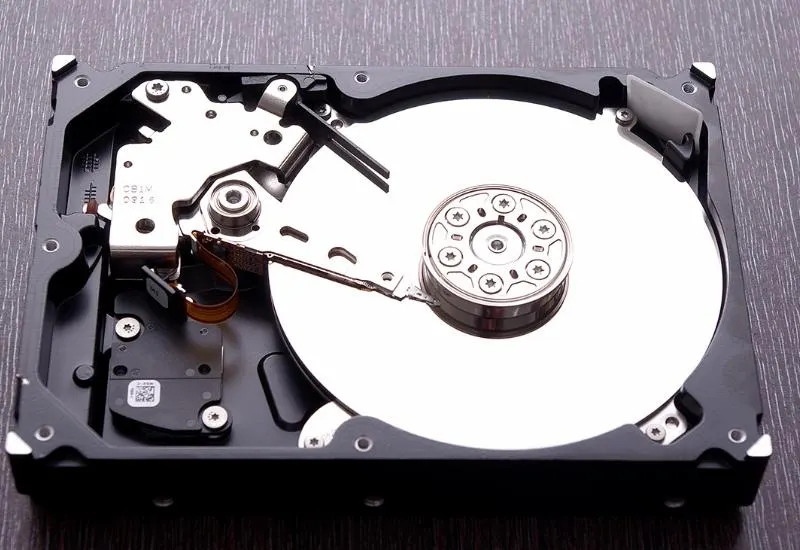
Main components of a hard drive
The main components of a hard drive are described below. This is not an exhaustive description: it is a general summary of each component and its purpose.
Reading and writing data
Data are written to or read from the platters by read heads, which are sensitive to the magnetic fluctuations of the platters spinning beneath them. These fluctuations are interpreted as the 0s or 1s of the binary format the computer understands. When the platter spins, a magnetic flux only a few microns thick forms beneath the heads. This is why hard drives are sealed at the factory and should only be opened under the appropriate circumstances.
The tolerance is so tight that even microscopic damage to the surface of the platters can permanently damage the drive. If small particles such as dust get in, the result can be disastrous.
To write, a circuit sends an electric current that produces a magnetic field between the head and the platter surface. The magnetic flux extends across the empty space and is implanted in a track on the platter surface, over which the head is positioned. The same process is used for reading: an electric current is induced in the coils when the gap passes over a change in magnetic flux on the surface of the platters. The hard drive controller manages the switch between reading and writing.
PCB controller
The hard drive controller, better known as the PCB (Printed Circuit Board), contains a processor, internal memory and other components and circuits that control what happens inside the drive. It is like having a small computer inside the hard drive. Among other things, it performs these functions:
- Controlling the spindle motor, including checking that it spins at the correct speed.
- Controlling the movements of the coils to access the tracks.
- Managing read and write operations.
- Implementing power management solutions.
- Encoding and decoding the signals sent to or received from the read heads.
Motor
The spindle motor spins the platters and allows the drive to work. It must be stable, reliable and consistent in its rotation, for continuous use over thousands of hours without failure. Many hard drive problems are directly related to spindle motor instability. The motor must vibrate as little as possible, because of the tight tolerances of the read heads.
Coils (Voice Coil)
The coils move the head arms in and out across the surface of the platters. They use a feedback system called Servo to dynamically position the heads over the desired tracks. They work by electromagnetic attraction and repulsion, and the distance the arms travel is regulated by the amount of current sent to the coils.
Platters
The platters of a hard drive are not removable (unlike a floppy disk). Several disks are positioned vertically, fixed to the shaft of a high-speed electric motor. The rigid material of the platters must withstand the pressure imposed by high rotational speeds and temperature. Metal is normally used, although glass and ceramic have also been used.
Because metal platters withstand changes much better than the plastic platters of a floppy disk, they can be subjected to much greater pressure with fairly reliable results. A hard drive platter can spin at 7,200 rpm (revolutions per minute) or more, while a traditional floppy disk is limited to about 300 rpm. The higher the rotational speed, the faster the data access and output time.
The platters are coated on both sides with a thin layer of a magnetic substance (iron oxide or metal magnetic film) for non-temporary memory. The surfaces are usually lubricated to minimize wear during startup and shutdown. As a result, the platters are quite hard and much less susceptible to head-crash damage (the heads coming into contact with the platter surface).