


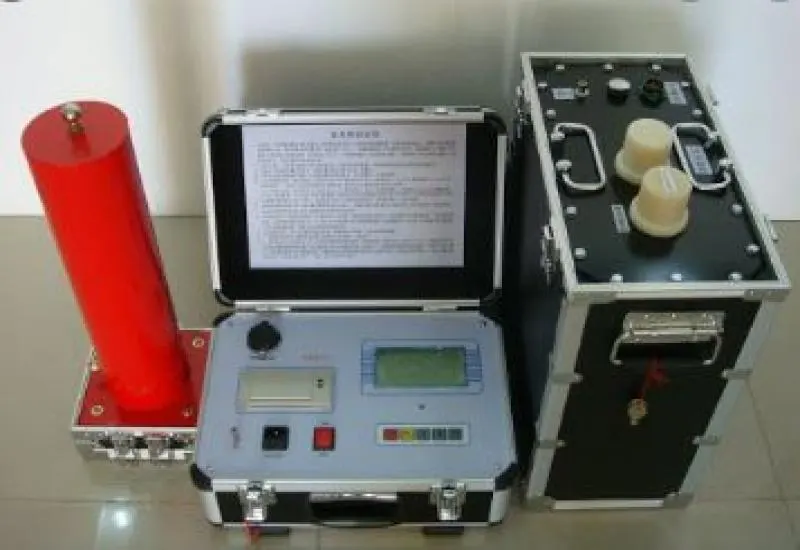
VLF testing of XLPE cables
VLF testing uses very low frequencies as part of an AC cable maintenance routine. VLF testers are smaller and more practical than AC testers, yet they offer the same power as a 50 Hz mains device. That combination of size and power makes them suitable for testing long sections of cable and equipment.
Why VLF and not AC at power frequency
AC is the standard for electricity supply worldwide, normally at 50 or 60 hertz. VLF testing works within these parameters.
However, supplying power with alternating current is not as efficient as doing so with direct current. All transmission lines and cable networks have DC resistive loss at the supply voltage, and capacitive loss is even greater, largely because of the inherent coupling between phases. This is why generating systems must supply enough energy for the demand and to compensate for the large transmission losses.
The small size and high power of the VLF tester help solve the transmission loss problem during an AC test on very long sections of cable and equipment in the field. It also eliminates the need for on-site generation, large step-down transformers or utility supplies to power the items under test.
0.1 Hz operating frequency
VLF tests work at 0.1 Hz, compared with the normal 50/60 Hz of live-line transmission, so the size of the test set is greatly reduced. The test object still receives the sinusoidal alternating voltage of its everyday use, with much smaller test equipment.