


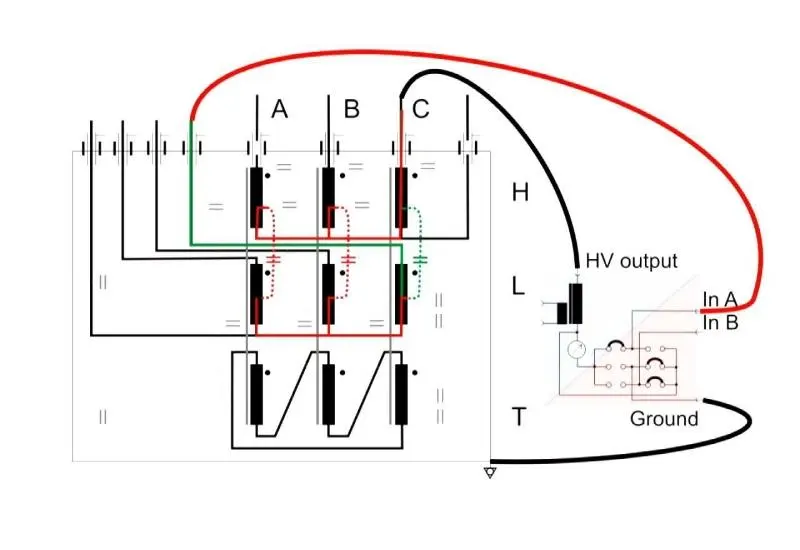
What the test is for
We perform insulation power factor analysis with automatic equipment up to 10kV.
The main objective is to determine the operating condition of the insulation. The test identifies changes in its dielectric properties due to contamination or aging.
How it is done
The object under test is represented as a capacitor in parallel with a resistor.
The test consists of applying alternating current voltage (VAC) to the object under test and measuring the current (A), the voltage (V) and the power (W).
Watts are measured directly. Volt-amperes (VA) are the product of voltage and current, although in practice the test set displays the VA value directly.
Calculating the power factor
The starting point is the power triangle:
- X axis: the watts dissipated in the insulation. They correspond to the resistive part of the object under test.
- Y axis: the reactive volt-amperes consumed by the insulation. They correspond to the capacitive part.
- The vector sum of the two is the apparent power (VA).
By definition, the power factor is the cosine of the angle between the watts and the volt-amperes, known as angle q. That is: power factor = Cos q = adjacent side / hypotenuse = watts / VA. It is a dimensionless quantity.