


Power factor and tan delta in dielectric oil
We analyze the power factor or tan delta and the resistivity of dielectric insulating oil up to 10kV in Monterrey. We run dual-frequency tests: 45Hz/55Hz, 47.5Hz/52.5Hz, 55Hz/65Hz and 57.5Hz/62.5Hz. We use automatic equipment.
We perform different types of power factor tests, on oil and on other insulating liquids. We can perform the Tip Up test: we plot dielectric loss and dielectric absorption against different applied voltages, to observe the ionization process, infer whether partial discharges are present and identify insulation aging in accordance with IEEE Std 286-2000.
What power factor measures
Insulation power factor analysis is an AC test that applies voltage and measures the leakage or loss current of the electrical insulation. It is used to evaluate the integrity of any electrical insulation.
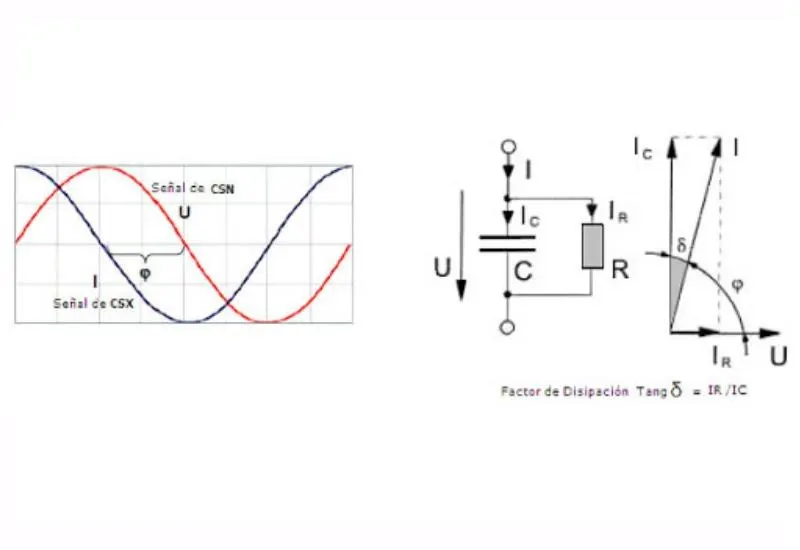
Power factor is the cosine of the phase angle between voltage and current. For ideal insulation, the phase angle is 90°, and cos(90) = 0. No insulation is ideal: a small current, called leakage current, flows through the insulation and has two components:
- Resistive current.
- Capacitive current.
Under real conditions, in addition to the capacitive current, a resistive (or loss) current appears in phase with the voltage.
Our YouTube videos:
Tip Up test on motors and bushings
On motors, the Tip Top test is recommended for stator voltages of 6600 V and above, on the complete stator. It gives a baseline for later detecting, in maintenance tests, corona discharge within the insulation system. It can also be specified on sacrificial coils for development tests, but the acceptance criteria must be agreed between user and supplier.
The power factor tip-up test is usually performed at 10% and 110%, or at 20% and 120%, of the line-to-ground supply voltage rating. The results are plotted for each motor and the percentage deviation is calculated. If several motors of the same design are tested and compared, the values should be similar. Any motor that deviates significantly should be investigated for possible winding or insulation problems. It is an excellent test for determining conductive contamination in a winding.
When the measurements are finished, the values should be compared with previous results and with the reference values in the standards for the asset tested. An increase in capacitance of more than 10% over previous results is normally considered dangerous for bushings: it indicates that part of the insulation distance is already compromised and that the dielectric stress on the remaining insulation is too high. An additional voltage tip-up test can detect poor contacts in the bushing layers or the measuring tap, which are recognized by a decrease in PF/DF.
Standard PF/DF measurements at 50 Hz or 60 Hz detect the effects of moisture and aging only at an advanced stage. Measuring over a wider frequency range detects them earlier and leaves more time to schedule corrective action. If a high PF/DF is detected, dielectric response analysis serves as an additional diagnostic method: this broadband measurement can determine whether the cause is moisture or high oil conductivity.
Copper sulfide contamination in transformer windings
In recent years much work has been done to determine whether an oil contains corrosive sulfur, including methods for finding out whether it will react with copper and form deposits on the insulating paper, and the tendency of some oils to become corrosive over time and with temperature. So far, oil tests report only on the characteristics of the oil itself, not on whether the windings have been compromised by copper sulfide deposits on the conductor or on the insulating paper around it. Since this contamination can lead to transformer failure through compromised insulation, it is very important to be able to assess the condition of the winding.
Doble began a research program to determine which electrical tests could detect copper sulfide in a winding. Techniques such as DFR (dielectric frequency response), SFRA (sweep frequency response analysis), leakage reactance and normal power factor measurements were used, but they did not give satisfactory results or usable diagnostic information.
Online partial discharge tests are not always useful for warning of an imminent failure either, because many failures do not show the gassing typical of an incipient fault. In several failure investigations, DGA samples taken shortly before the failure (in one case, the day before) showed the same gassing profile as earlier samples, with no increase in the combustible gases associated with partial discharge.
In most of the failures reviewed, copper sulfide contamination is highly localized. The test technique would have to stress the winding until that localized contamination appeared as a deviation from a normal value, the one obtained on an uncontaminated winding.
The research showed that a variation of the Doble power factor test, with test voltages above 10 kV and up to 35 kV, gave very demanding results when copper sulfide was present, both in research samples and in real transformers. It was called the "high-voltage power factor test or Tip Top test".
What the power factor Tip Up test is
If the measured power factor increases as the applied voltage rises, this is known as Tip Up. Experience shows that transformers with good insulation do not show Tip Up. Normal power factor testing is generally performed between 2 and 10 kV.
This test matters here because moisture and polar by-products do not influence Tip Up. It is caused by discharge, partial discharge activity or its by-products, and conductive materials such as fine metal residues and copper sulfide. That is why it is an excellent test for determining conductive contamination in a winding.
Laboratory studies under controlled conditions showed that power factor Tip Up was the most sensitive and distinctive indicator of copper sulfide contamination. The more severe the deposit, the higher the power factor and the Tip Up (figure 1).
In figure 1, insulating paper contaminated with different amounts of copper sulfide did not require more than 10kV to show the effects of the contamination in the Tip Up. The blue line represents uncontaminated paper and shows a straight line as the voltage rises. Samples 2 to 4 show an increase in power factor with voltage. The increase (tip-up) is directly related to the amount of copper sulfide: sample 4 has the most contamination, then 3, and 2 has the least.
In experiments with contaminated winding sections, transformers and reactors, the voltage needed to achieve power factor recovery was always above 10 kV and up to approximately 30 kV, depending on the apparatus and the configuration.
How the high-voltage Tip Up is performed
The measurement uses several pieces of instrumentation. The Doble M4100 (power factor measurement system) or other measuring bridges, serving only as the measuring instrument, are operated together with an external reference and power supplies.
- The external reference, typically a capacitor, allows the M4100 to measure the test voltage. The M4100 controls the voltage, displays the test potential and uses it as a reference to calculate the real and reactive components of the measured current.
- The external power supply, generally a step-up transformer, provides the test potential. In grounded specimen test (GST) mode, it must be designed so that its losses are guarded. So that they do not affect the GST measurement, the guard plane of the supply must remain isolated from ground and connected to the guard point of the M4100.
Conclusion
Transformers suspected of corrosive sulfur contamination should undergo oil testing. In addition, the condition of the windings, which is the limiting factor in copper sulfide contamination, can be determined with the high-voltage power factor Tip Up test. Doble can provide an application note with details of the test with the Doble M 4100.
Once the connections to the transformer are made, the test is easy to perform and takes only a few hours. There is no need to model the transformer. The results are easy to define, report whether or not conductive contamination such as copper sulfide is present, and give a relative indication of its severity.