


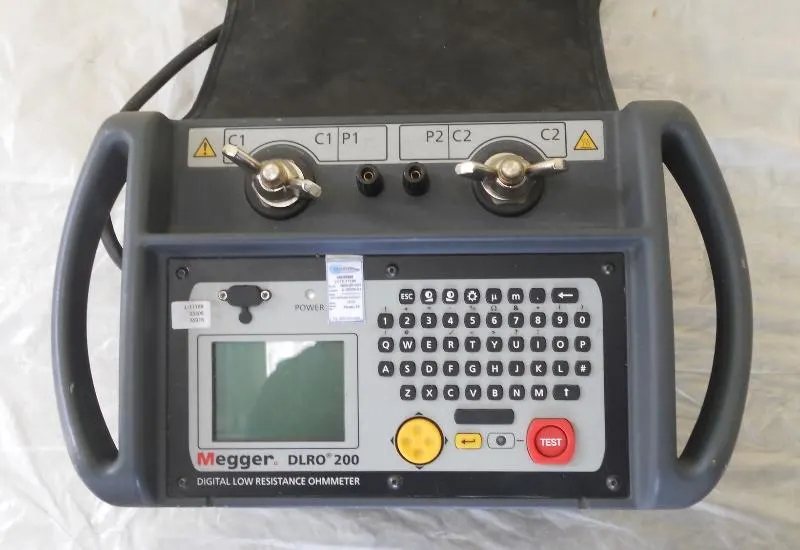
Ducter: low-resistance meters for rent
We rent out low-resistance equipment and meters (milliohm, microhm) for circuit breakers, disconnect switches, busbars and windings in Monterrey, commonly known as a ducter (Conductor Test). We have 10-amp units, or units of up to 100 amps if you need more current, IN STOCK. They are used to test circuit breaker contacts, switched contacts, busbar joints and other applications where high current is needed. We measure down to microhms with a 4-wire configuration, for greater accuracy.
Ideal for testing
- Circuit breaker contacts and switches
- Transformers and generators
- Motor windings
- Busbars and busbar joints
- Splices, welds and fuses
- Metal alloys
- Graphite electrodes and other composite materials
At the other end of the scale, for high resistances, we also rent out professional Megger insulation analyzer megohmmeters of up to 10 Tera ohms 10Kv, to measure high resistances and carry out other insulation tests.
How to measure low electrical resistances
Measuring low electrical resistances, of a few ohms or less than one ohm, is not common. If you use a multimeter, the resistance of the leads is added to the resistance you want to measure and the reading has a very large error. Modern multimeters have a function for subtracting lead resistance; Fluke meters have the REL function. You short the probes, apply REL so that it reads zero ohms, and then measure the desired low resistance. This method works when high accuracy is not required. For greater accuracy, the most suitable method is 4-wire.
Why test circuit breakers?
Circuit breakers are among the most important components of modern electric power systems. They must operate within very tight tolerances when a disturbance is detected on the grid, to protect sensitive and costly components such as transformers. They must operate after months or, in some cases, years of inactivity. Reliable and effective test instruments and methods are needed to guarantee their correct operation and optimize grid reliability. New developments make it possible to improve on conventional methods, which sometimes take a long time and involve complicated steps.
Among the most important reasons for testing them is to ensure that they:
- Protect costly equipment.
- Prevent failures that cause loss of revenue.
- Guarantee the reliability of the electricity supply.
- Prevent service interruptions and blackouts.
- Deliver the expected circuit breaker performance.
Testing substation circuit breakers is an important task for any power utility. Circuit breakers allow current to flow in normal operation and interrupt the current in the event of a short-circuit or overcurrent fault. Even so, all electrical devices can fail sooner or later, through aging, external faults and other factors. The utility operator must be prepared and have a plan for every situation. Circuit breakers are mechanically sophisticated devices that require periodic adjustment.