


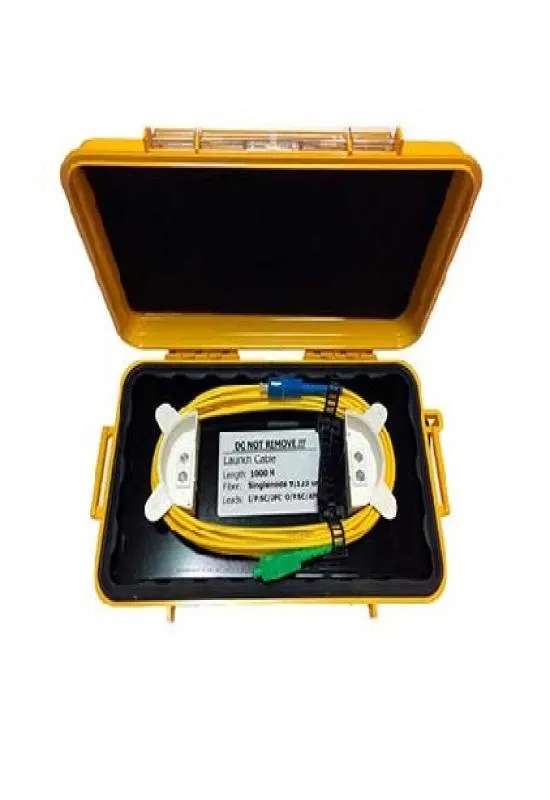
What it is and what it does
The launch spool, or reference spool, is a key component in fiber optic testing, especially with equipment such as the OTDR (Optical Time-Domain Reflectometer) and other optical measuring instruments.
It is used to launch a test signal from the measuring equipment into the fiber under test. It provides a known, stable length of fiber, which allows attenuation and reflection along the fiber to be measured accurately.
Main features
- Known length: it has a specific length of optical fiber, which can be several hundred meters or more, depending on the test requirements.
- Connectivity: it connects directly to the measuring equipment and the fiber under test, safely and reliably.
- Protection: it often comes on a reel or in a box that protects the fiber from physical damage during use and storage.
Importance
- Calibration: it allows the measuring equipment to be calibrated by providing a known length and attenuation reference.
- Avoids saturation: by launching the signal from a known length, it helps avoid saturating the equipment receiver and ensures accurate measurements.
- Test standards: it is required to meet quality test standards in fiber optic network installations, with consistent, reliable measurements.
Remember that the dead zone is the initial section of an installation that an OTDR cannot read accurately; it indicates how close the OTDR can read a refraction event.