


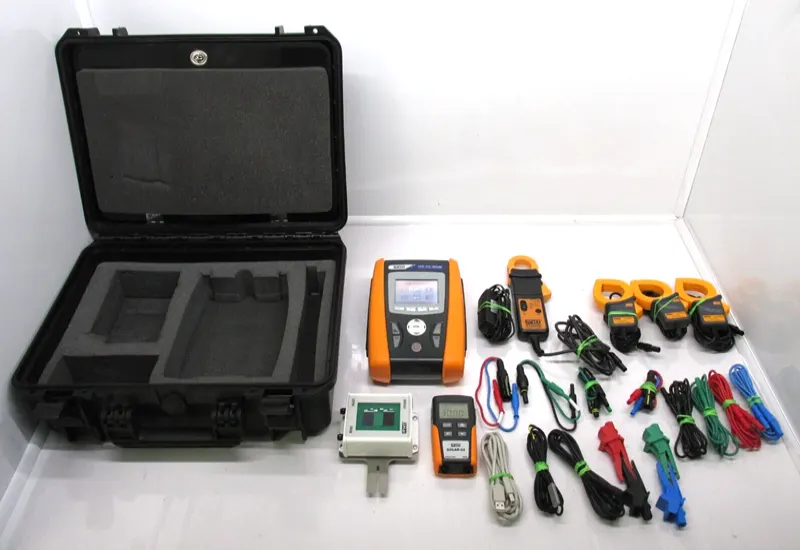
At Electronica Monterrey we rent the HT Instruments Solar 300N and its complementary accessories. With it you can analyze your solar power system and verify its operation.
The HT Instruments Solar 300N is a measurement and analysis device designed for solar photovoltaic applications.
What it can measure
Solar radiation
It measures incident solar radiation, that is, the solar energy reaching the surface of a panel over a given area. This measurement is used to assess the generation potential of a location and to size a photovoltaic system.
Temperature
It measures the temperature of the solar panels and other system components. This matters because rising temperature can affect panel efficiency and reduce energy output.
Current and voltage
It takes current and voltage measurements at different parts of the system, such as panels, inverters and batteries. This makes it possible to detect loose cables, faulty connections or malfunctioning panels.
Continuity and diodes
It performs continuity tests on cables and connections, and diode tests on the solar panels to verify their operation.
Other features
Analysis software
Some Solar 300N models may come with specialized software for analyzing data and generating reports, with graphical data display, performance metric calculation and custom reports.
Industry standards
The instrument is designed to meet the quality and accuracy standards of the photovoltaic industry.
Ruggedness
Because it can be used outdoors and in changing weather, it is usually built to be tough: weatherproof housings, screens protected against intense sunlight and internal components for adverse conditions.
Data storage
It may include internal storage for saving measurements and tracking the performance of the solar system over time.
Calibration and maintenance
To preserve accuracy, the instrument must be calibrated periodically according to the manufacturer’s specifications. It may also require regular maintenance.
In short, the Solar 300N is used to measure solar radiation, assess temperature, analyze currents and voltages, and perform continuity and diode tests on photovoltaic systems.