


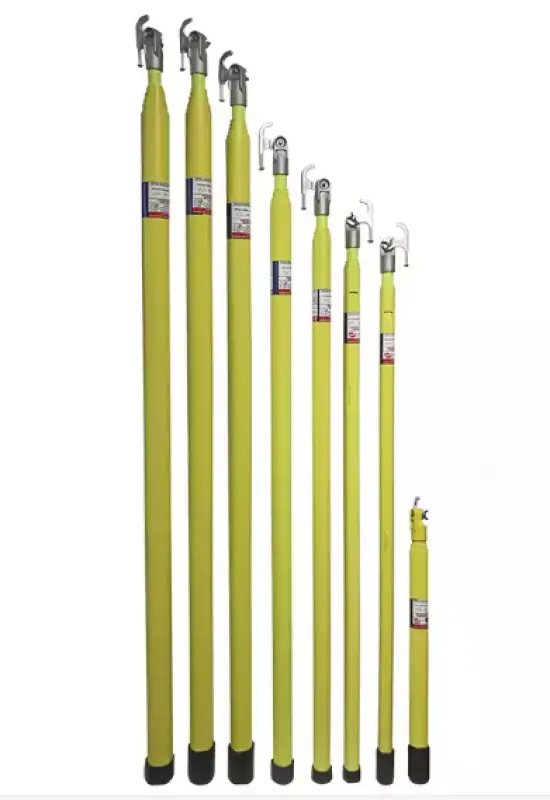
Rental of hot sticks, rescue hooks and arc flash suits
At Creativeit we rent multi-section hot sticks. If in stock, we immediately deliver hot sticks and rescue hooks, as well as electric arc or arc flash suits.
Worker safety, especially in tasks that put physical integrity and health at risk, demands personal protective equipment. That is why companies must supply tools and items that give their personnel high levels of safety.
We calibrate hot sticks and dielectric gloves with high-voltage hipot equipment. At Creativeit Group we calibrate all types of hot sticks and other dielectric equipment.
What dielectric hot sticks are
They are tools that provide safe distance and insulation in live work and in tasks that require operating elements at a great distance or height, such as high-voltage poles. They protect the worker against electric shock, burns and other accidents.
They are strong dielectric poles, easy to maintain, that allow multiple tools to be attached to the tip. They are made as polyester resin tubes, reinforced with fiberglass or other dielectric materials, and they replaced wooden poles.
They are used for operations on high-voltage electrical installations and for disconnecting. We have hot sticks for every application:
- Universal
- Fuse replacement
- Discharge to ground
- Telescopic
- Shotgun
- Rescue
- Grounding systems
- Voltage detectors
Types of hot sticks
Telescopic hot sticks
These are used for remote mechanical work on the electrical side, such as opening and closing, electrical isolation, detection, voltage verification and, in general, light tasks. They get their name because one section slides inside the other, and they extend to the desired length.
Telescopic hot sticks come with two to nine sections and reach up to 12 meters, so detection or isolation can be done from below, without climbing the pole. They extend and retract with the locking button and are easy to transport: collapsed, they measure approximately 1.5 m.
The tip section is the rigid part and the most important one, so it is fully insulated. It is filled with polyurethane foam to prevent moisture from entering; the other sections are hollow. They are used in vertical-position operations, at a slight angle and with little weight.
All sections undergo the dielectric test of the ASTM standards, which state that every 30 cm must withstand 100 kV.
Single-section hot sticks, the most common
One section is placed on top of the other: a base section, three or four intermediate sections and a tip section. All sections are filled with polyurethane foam and the fiberglass layer is thicker than on telescopic sticks.
They are rigid and suit all types of switching work. Their rigidity and stability make them ideal for temporary grounding, where telescopic sticks are not as advisable, since the weight could damage or even break them.
Insulating hot sticks (shotgun and retractable hook types)
These are used for all types of work: the operation is done with a trigger that allows you to tighten, loosen or place the temporary ground. They are also rigid and are used for isolation and detection; they are excellent for fitting tools with adapters.
Maintenance
Their maintenance is simple, but keep these recommendations in mind:
- Keep them in their carrying cases, in a place with no exposure to sun or water.
- Protect them from impacts, scratches and poor storage.
- Inspect them before use and clean them to remove dust and moisture.
- Check the insulation condition of the hot stick with a hot stick tester.
- Perform the dielectric strength test at least once a year. We do it in the field or at our laboratory in Monterrey, Nuevo León, Mexico.
Controlling and preventing occupational risks with protective equipment creates a safe environment and protects your company from costly workplace accidents.